
Single Triangle and Component Vectors in Equilibrium
Loading the math board and drawing, please wait…
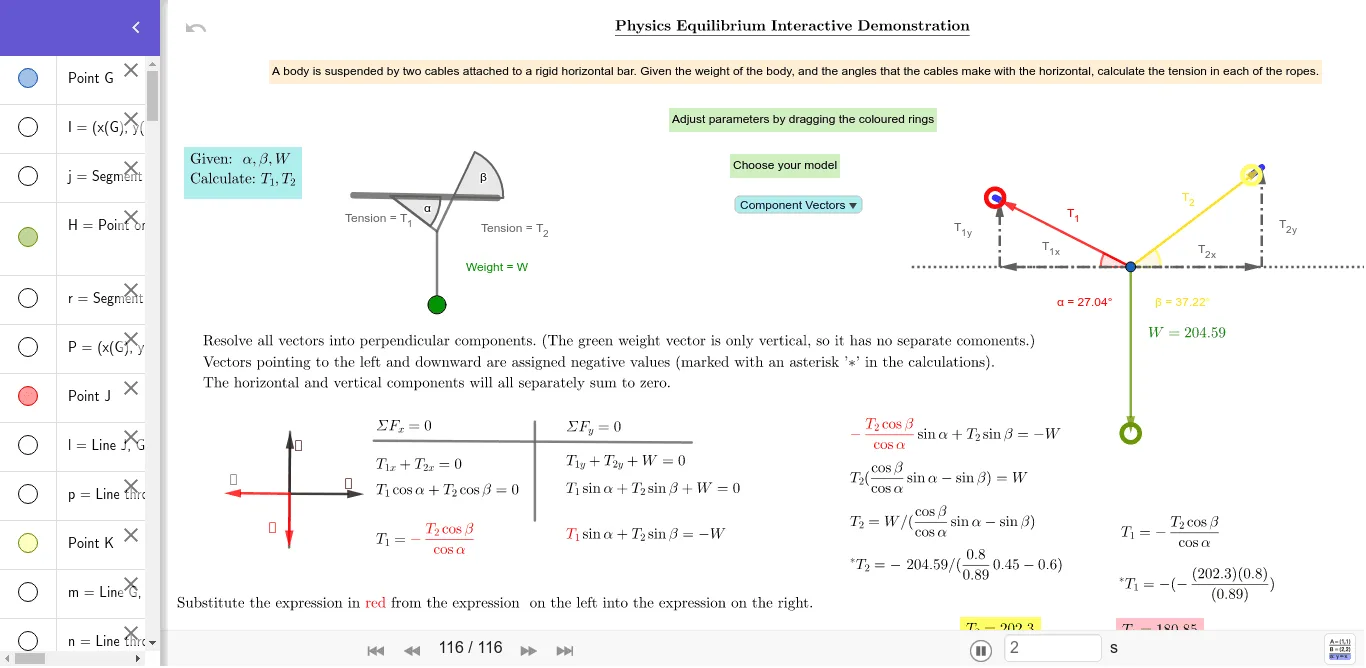
This example demonstrates the equilibrium state of a single triangle under the influence of component vectors. Key mathematical concepts include vectors and trigonometry. Using GeoGebra commands such as Segment, Point, Line, Intersect, Vector, Translate, Angle, etc., it provides a visual representation of vector synthesis and decomposition. Suitable for high school physics and mathematics education.
GeoGebra Commands & Parameters
Segment(G, I) → jPoint(j) → HSegment(G, H) → rLine(J, G) → lLine(P, l) → pLine(G, K) → mLine(P, m) → nIntersect(n, l) → OVector(G, O) → vIntersect(p, m) → QVector(G, Q) → wTranslate(R, v) → R'Translate(R', w) → R''Angle(R'', R', R) → ηVector(G, H) → uOrthogonalLine(G, u, xOyPlane) → kIntersect(n, k) → MAngle(O, G, M, xOyPlane) → γAngle(R', R'', R) → εSegment(A, B) → fPoint(f) → CPoint(f) → DSegment(C, E) → gSegment(E, D) → hSegment(E, F) → iAngle(f, g) → αAngle(f, h) → βSegment(P, G) → qLength(q) → aLength(r) → bSegment(J, O) → sSegment(Q, K) → tIntersect(p, k) → NAngle(Q, G, N, xOyPlane) → δ_1SelectedElement(L) → text8Vector(R, R') → cVector(R', R'') → dTranslate(R'', u) → R'''Vector(R'', R''') → eOrthogonalLine(R', e, xOyPlane) → f_1Segment(R'', R) → g_1Intersect(f_1, g_1) → SAngle(S, R', R, xOyPlane) → ε_1Angle(R'', R', S, xOyPlane) → ζAngle(R', R, R'') → δSegment(R', S) → h_1Segment(M, N) → i_1OrthogonalLine(O, i_1, xOyPlane) → j_1OrthogonalLine(Q, i_1, xOyPlane) → k_1Intersect(i_1, j_1) → TIntersect(k_1, i_1) → UVector(G, T) → u_1Vector(T, O) → v_1Vector(G, U) → w_1Vector(U, Q) → a_1Segment(V, W) → l_1Segment(Z, A_1) → m_1Intersect(l_1, m_1) → B_1Vector(B_1, Z) → b_1Vector(B_1, W) → c_1Vector(B_1, A_1) → d_1Vector(B_1, V) → e_1Segment(C_1, D_1) → n_1Segment(E_1, F_1) → p_1
AI Drawing Prompt Reference
Draw a triangle ABC with points A, B, and C on segment f, forming angles α, β, and γ with segments g, h, and i. Construct vectors v, w, and u from point G, and demonstrate the synthesis and decomposition of vectors v, w, u, c, d, and e at points G, R, R', and R''. Finally, show the angle relationships between vectors v, w, u, c, d, and e.
The prompt above was compiled from the original drawing commands and is for reference only.