
Sine Function and CAST Rule
Loading the math board and drawing, please wait…
In collections
Trigonometric Graphs and the Unit Circle
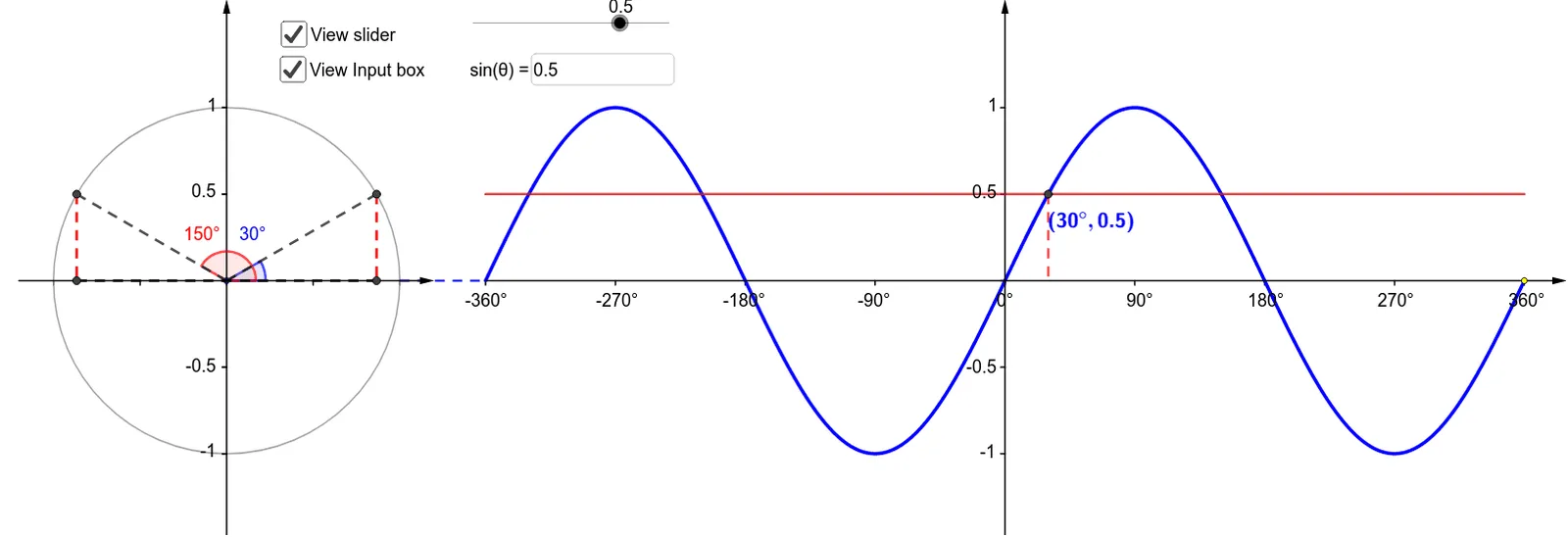
This example demonstrates the sine function graph and its relationship with the CAST rule. The CAST rule is a mnemonic used in trigonometry to determine the sign of the sine function in different quadrants. By constructing the sine function graph, users can visually understand the periodicity, symmetry, and sign changes of the sine function in different quadrants. The construction uses commands such as Point, Vector, Circle, Sequence, Segment, and Textfield in GeoGebra. Suitable for high school mathematics education and students learning about the properties of the sine function.
GeoGebra Commands & Parameters
Point(Ray[(0, 0), (-1, 0)]) → BVector((x(B), y(Corner[1])), (x(B), y(Corner[4]))) → uVector(B - (1.2, 0), B + (1.2, 0)) → vCircle(B, A) → cVector((0, y(Corner[1])), (0, y(Corner[4]))) → wVector((0 - x(Q), 0), (x(Corner[2]), 0)) → zSequence(Segment[((0.75 * i), 0), ((0.75 * i), -0.025)], i, -4, 4) → list1Sequence(Segment[(0, (0.5 * i) - 1), (-0.025, (0.5 * i) - 1)], i, 0, 4) → list2Sequence(Segment[(x(B), (0.5 * i) - 1), (x(B) - 0.025, (0.5 * i) - 1)], i, 0, 4) → list3Sequence(Segment[B + ((0.5 * i) - 1, 0), B + ((0.5 * i) - 1, -0.025)], i, 0, 4) → list4Segment(A, ((-x(Q)), 0)) → dTextfield(asintheta) → InputBox1Intersect(c, g) → E, FSegment(F, B) → iSegment(E, B) → jOrthogonalLine(F, v, xOyPlane) → kOrthogonalLine(E, v, xOyPlane) → lIntersect(k, y = 0) → HIntersect(l, y = 0) → ISegment(F, H) → mSegment(E, I) → nSegment(H, B) → pSegment(I, B) → qSegment(P, (x(P), 0)) → rAngle(H, B, F, xOyPlane) → βAngle(F, B, H, xOyPlane) → εAngle(H, B, E, xOyPlane) → γ