
Trigonometric Ratios Demonstrated with Unit Circle Generator
Loading the math board and drawing, please wait…
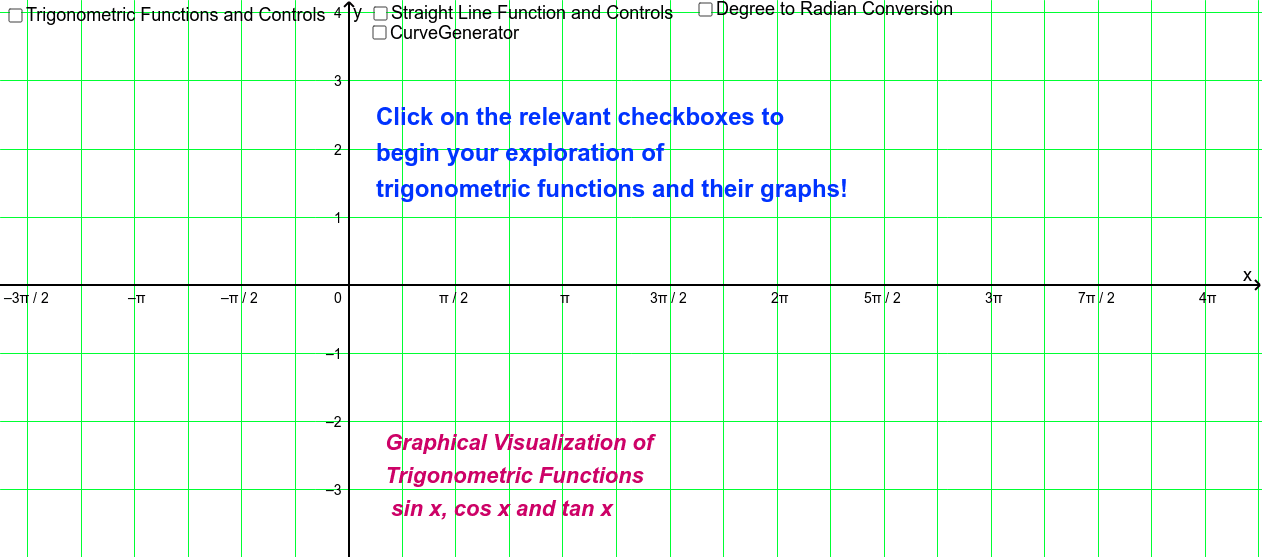
This example uses GeoGebra's dynamic tools to illustrate trigonometric ratios on the unit circle, showing the geometric meaning of sine, cosine, and tangent functions through interactive circles and angles. The core mathematics include the definitions of trigonometric functions, their parametric representation on the unit circle, and the derivation of ratio relationships. The construction employs commands such as Function, Circle, Angle, Ray, and Sequence, and defines objects like intervalUpper, intervalLower, Φ, etc., to generate adjustable angles and corresponding points. It is suitable for high‑school mathematics instruction and introductory college trigonometry courses.
GeoGebra Commands & Parameters
Function(a * tan(b * x + Φ) + d, intervalLower, intervalUpper) → hFunction(a * cos(b * x + Φ_c) + d, intervalLower, intervalUpper) → gLineOver(A, e) → lSlope(l) → m_1Function(a * sin(b * x + Φ) + d, intervalLower, intervalUpper) → fFunction(a * sin(b * x) + d, intervalLower, intervalUpper) → f_bFunction(a * cos(b * x) + d, intervalLower, intervalUpper) → g_bFunction(a * tan(b * x) + d, intervalLower, intervalUpper) → h_bFunction(d, intervalLower, intervalUpper) → f_cPoint(xAxis) → DPoint(Circle[D, r_1]) → ESegment(D, E) → sCircle(D, E) → tPoint(t) → GSegment(D, G) → a_1Segment(H, G) → b_1Segment(D, H) → d_1Angle(E, D, G) → αSegment(X_x, P_s) → c_1Segment(X_x, P_c) → e_1Ray(D, G) → f_1Segment(X_x, P_t) → g_1Segment(H, G) → h_1Sequence((i, 0.0), i, (intervalLower * 180.0 / 3.141592653589793)°, (intervalUpper * 180.0 * 3.141592653589793)°, 90.0*°) → XaxisDegrees
AI Drawing Prompt Reference
Draw the geometric meaning of trigonometric ratios on a unit circle, showing the relationships between sine, cosine, and tangent functions. Start by drawing a unit circle and a ray from the center, marking angle α. Find point G on the ray intersecting the circle. Draw a perpendicular from G to the x-axis, meeting at point D. Then, draw a line from D perpendicular to the ray, intersecting the circle at E. Finally, show the segments connecting D to G, H to G, and D to H, and display the sine, cosine, and tangent values of angle α.
The prompt above was compiled from the original drawing commands and is for reference only.