
Simplifying Negative Exponent Expressions
Loading the math board and drawing, please wait…
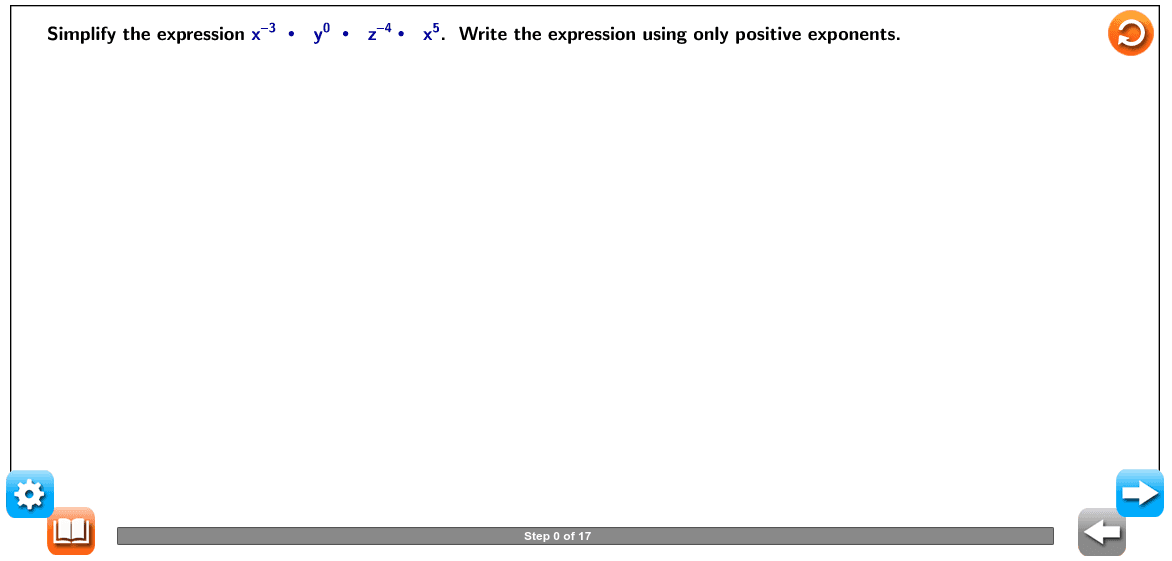
This example demonstrates how to simplify algebraic expressions containing negative exponents and rewrite them using only positive exponents. The core math concepts involved are exponent rules, particularly the multiplication of like bases and the addition/subtraction of exponents. The construction leverages the LaTeX command for mathematical formula display and various GeoGebra objects such as Border, Gear, Book, Nexbl, prebl, nexgr, pregr, Probar, Stepmax, Slider, Stepof, P, Q, DatakitBG, Dataclose, WordstoknowBG, Wordsclose, Originalbutton, RandomButton, Quadratic, Linear, Constant, Refresh_1, and Problue1-17 for interface layout and interactive design. It is suitable for high school students learning exponent operations, serving as a classroom demonstration or homework exercise.
GeoGebra Commands & Parameters
LaTeX("\text{Use the exponent rule \textcolor{#000099}{a^m\; • \;a^n = a^{m +n}} to simplify the expression.}") → Pg1BLaTeX("\text{To multiply powers with the same base, add the exponents.}") → Pg1CLaTeX("\text{Use the exponent rule \textcolor{#000099}{a^0 = 1} to further simplify the expression.}") → Pg1GLaTeX("\text{Use the exponent rule \textcolor{#000099}{a^{−m} = \frac{1}{a^m}} to write the negative exponent as a positive exponent.}") → Pg2ALaTeX("\text{To rewrite a negative exponent as a positive one, take its reciprocal.}") → Pg2BLaTeX("\text{\textcolor{#000099}{a^{−m} = \frac{1}{a^m}}}") → Pg2CLaTeX("\text{\mathbf{Exponent} \text the number of times a factor is being multiplied together in an}") → WTK1LaTeX((((((("\text{Simplify the expression \textcolor{#000099}{x^–^" * X1P) * "\; •\; y^0\; • \; z^–^") * X2P) * "\;•\; x^") * YP) * "}. Write the expression using only positive exponents.}")) → Pg1ALaTeX((((((((((("\text{In the expression \textcolor{#000099}{x^–^" * X1P) * "\; •\; y^0\; • \; z^–^") * X2P) * "\;•\; x^") * YP) * "}, the only terms with the same base are \textcolor{#000099}{x^-^") * X1P) * "} and \textcolor{#000099}{x^") * YP) * "}. To multiply these terms, add the exponents.}")) → Pg1DLaTeX((((((((((("\text{\textcolor{#000099}{x^-^" * X1P) * " \;•\; x^") * YP) * " = x^-^{") * X1P) * " + ") * YP) * "} = x^{") * X12P) * "}}}")) → Pg1ELaTeX((((((((((("\text{The expression \textcolor{#000099}{x^–^" * X1P) * "\; •\; y^0\; • \; z^–^") * X2P) * "\;•\; x^") * YP) * "} can now be simplified to \textcolor{#000099}{x^{") * X12P) * "} • \;y^0 •\; z^-^{") * X2P) * "}.}}")) → Pg1FLaTeX("\text{Any value to the \textcolor{#000099}{0} power equals \textcolor{#000099}{1}. Thus, \textcolor{#000099}{y^0 = 1}.}") → Pg1HLaTeX("\text{Substitute \textcolor{#000099}{1} for \textcolor{#000099}{y^0}.}") → Pg1ILaTeX((((("\text{The expression is now simplified to \textcolor{#000099}{x^{" * X12P) * "} • \;z^{–") * X2P) * "}.}}")) → Pg1KLaTeX((((("\text{\textcolor{#000099}{z^{−" * X2P) * "} = \frac{1}{z^") * X2P) * "}}}")) → Pg2DLaTeX((((("\text{Substitute \textcolor{#000099}{\frac{1}{z^" * X2P) * "}} for \textcolor{#000099}{ z^{–") * X2P) * "}}.}")) → Pg2ELaTeX((((((((((("\text{The expression \textcolor{#000099}{x^–^" * X1P) * "\; •\; y^0\; • \; z^–^") * X2P) * "\;•\; x^") * YP) * "} can be simplified to \textcolor{#000099}{\frac{x^{") * X12P) * "}}{z^") * X2P) * "}}.}")) → Pg2GLaTeX((((((((((((("\text{\textcolor{#000099}{x^{" * X12P) * "} •\; z^{−") * X2P) * "} = x^{") * X12P) * "} • \frac{1}{z^") * X2P) * "} = \frac{x^{") * X12P) * "}}{z^") * X2P) * "} }}")) → Pg2FLaTeX((("\text{Exponent of z = " * Constant) * "}")) → DK2LaTeX("\text{exponential expression; in the expression \textcolor{#000099}{a^b},\textcolor{#000099}{b} is the exponent.}") → Wtk2LaTeX((((((((((((("\text{\textcolor{#000099}{x^{" * X12P) * "} • \;y^0 •\; z^{–") * X2P) * "} = x^{") * X12P) * "} • \;1\;•\;z^{–") * X2P) * "} \; = x^{") * X12P) * "} • \;z^{–") * X2P) * "}}}")) → Pg1JLaTeX((("\text{Exponent of X₁ = " * Quadratic) * "}")) → DK1LaTeX((("\text{Exponent of X₂ = " * Linear) * "}")) → DK3