
Similarity Transformation and Surface Area
Loading the math board and drawing, please wait…
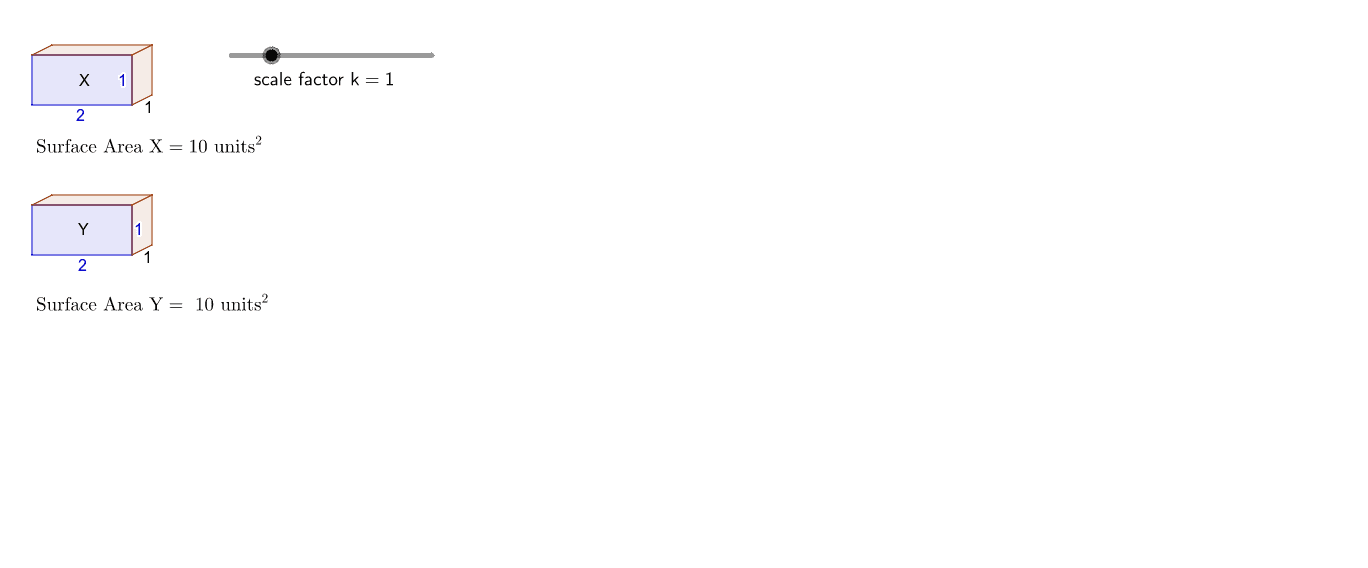
This example demonstrates the effect of similarity transformation on the surface area of a polygon. Key mathematical concepts include similarity transformation and surface area. Using GeoGebra commands such as Polygon, Intersect, and Point, different similar polygons are constructed and their surface areas are observed. Suitable for middle school and above students or teachers.
GeoGebra Commands & Parameters
Polygon(A, B, C, D) → poly1, a, b, c, dPolygon(E, F, G, H) → poly2, e, f, g, hIntersect(d, a) → IIntersect(b, a) → LPolygon(I, J, K, L) → poly3, i, j, k, lPoint(b) → MPolygon(M, N, K, L) → poly4, m, n, k_1, l_1Intersect(h, e) → OIntersect(f, e) → RPolygon(O, P, Q, R) → poly5, o, p, q, rIntersect(g, f) → SPolygon(S, T, Q, R) → poly6, s, t, q_1, r_1
AI Drawing Prompt Reference
Draw a quadrilateral and a similar quadrilateral, marking their vertices. Connect the midpoints of a pair of opposite sides of the first quadrilateral to form a third quadrilateral. Connect the midpoints of the corresponding sides of the first quadrilateral to the midpoints of the third quadrilateral to form a fourth quadrilateral. Repeat this process for the second quadrilateral to form fifth and sixth quadrilaterals. Observe the size and shape relationships among these quadrilaterals.
The prompt above was compiled from the original drawing commands and is for reference only.