
Scale Factor and Volume of Rectangular Prism
Loading the math board and drawing, please wait…
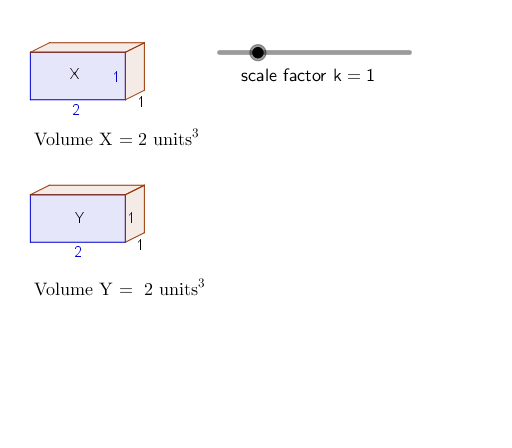
This example demonstrates the relationship between the scale factor and the volume of a rectangular prism. Key mathematical concepts include scale factor and volume calculation. Using GeoGebra commands like Polygon, Intersect, and Point, the example dynamically shows how the volume of similar rectangular prisms changes. Suitable for middle school and above students to learn geometric transformations and volume calculation.
GeoGebra Commands & Parameters
Polygon(A, B, C, D) → poly1, a, b, c, dPolygon(E, F, G, H) → poly2, e, f, g, hIntersect(d, a) → IIntersect(b, a) → LPolygon(I, J, K, L) → poly3, i, j, k, lPoint(b) → MPolygon(M, N, K, L) → poly4, m, n, k_1, l_1Intersect(h, e) → OIntersect(f, e) → RPolygon(O, P, Q, R) → poly5, o, p, q, rIntersect(g, f) → SPolygon(S, T, Q, R) → poly6, s, t, q_1, r_1
AI Drawing Prompt Reference
Draw a rectangular prism and then enlarge it with different scale factors to observe how the volume changes. First, draw a rectangular prism, then draw another similar but differently scaled rectangular prism, and gradually draw their sections and sub-prisms to show how the volume changes with the scale factor.
The prompt above was compiled from the original drawing commands and is for reference only.