
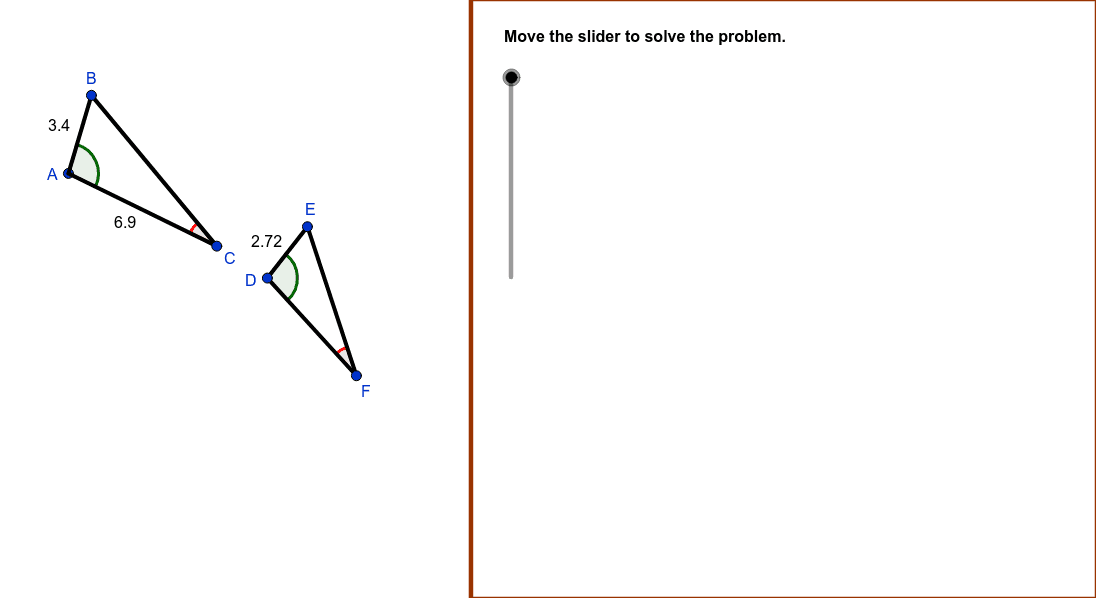
Similar Triangles: Proving △ABC ∼ △DEF and Finding Length DF
Loading the math board and drawing, please wait…
This GeoGebra example demonstrates how to prove that triangle ABC is similar to triangle DEF, and then determine the length of segment DF using similarity ratios. The core mathematical concepts include similar triangle criteria, proportionality of corresponding sides, segment length computation, and geometric transformations such as rotation and translation. The construction relies on GeoGebra commands Circle, Point, Polygon, Angle, Segment, Rotate, Ray, and Intersect, with objects including disAC, disAB, disDE, disDF, AB, AC, BC, DE, DF, EF and points A, B, C, D, E, F. Slider objects SliderDirections and steps, together with Mask masks, support step-by-step dynamic demonstration. It is designed for middle school geometry classes and high school review of similar triangles, suitable for interactive teaching and independent student exploration.
GeoGebra Commands & Parameters
Circle(A, disAC) → dPoint(d) → CCircle(A, disAB) → cPoint(c) → BPolygon((11, y(Corner[1])), Corner[2], Corner[3], (11, y(Corner[4]))) → Mask, mask4, mask3, mask2, mask1Angle(B, C, A) → BCAAngle(C, A, B) → CABCircle(D, disDE) → eSegment(A, B) → ABSegment(C, A) → ACSegment(C, B) → BCCircle(D, disDF) → fPoint(e) → ERotate(E, (-CAB), D) → F2Segment(D, E) → DERay(D, F2) → R2Intersect(f, R2) → F,Angle(E, F, D) → EFDSegment(F, D) → DFSegment(E, F) → EFAngle(F, D, E) → FDE
AI Drawing Prompt Reference
Draw two similar triangles ABC and DEF, showing that their corresponding angles are equal, and construct triangle DEF by rotating and translating point E. Calculate the length of segment DF using similarity ratios, with the diagram including multiple circles, points, segments, and angles, all dynamically adjustable with sliders.
The prompt above was compiled from the original drawing commands and is for reference only.