
Similar Triangles and Polygon Division via Dilation
Loading the math board and drawing, please wait…
In collections
Concept of Similarity
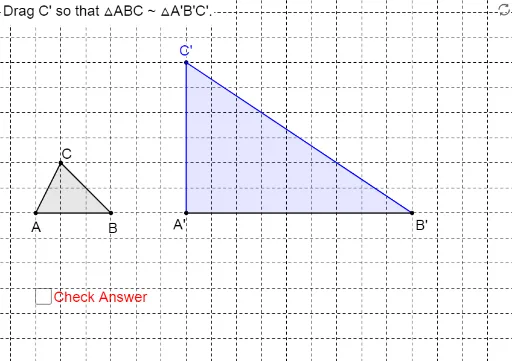
①This example demonstrates the construction of similar triangles through dilation (Dilate) and shows proportional relationships among polygons divided by segments. ②Core mathematical concepts include similar triangles, dilation transformation, proportional properties of polygon areas and side lengths, and the geometric interpretation of arithmetic mean. ③Construction details: using GeoGebra commands Polygon to create poly1, poly2, poly3; Point to define key points A, B, C, D, E, F; Segment to draw lines a, b, c, d, e, f; Dilate to scale points A', B', C'; text1 and text2 for labeling; Export_1 and Export_2 for output. ④Suitable for middle school geometry lessons to teach similarity criteria, dilation applications, and dynamic exploration of shape division and ratio relationships, also useful for connecting arithmetic mean with geometric configurations.
GeoGebra Commands & Parameters
Polygon(A, B, C, D) → poly1, a, b, c, dSegment(A', B') → ePolygon(A', B', C') → poly2, e_1, a', b'Point(Ray[E, E + (1, 0)]) → FDilate(Polygon[Translate[A, Vector[A, E]], Translate[B, Vector[A, E]], Translate[C, Vector[A, E]], Translate[D, Vector[A, E]]], Segment[E, F] / Segment[A, B], E) → poly3