
Similar Polygons
Loading the math board and drawing, please wait…
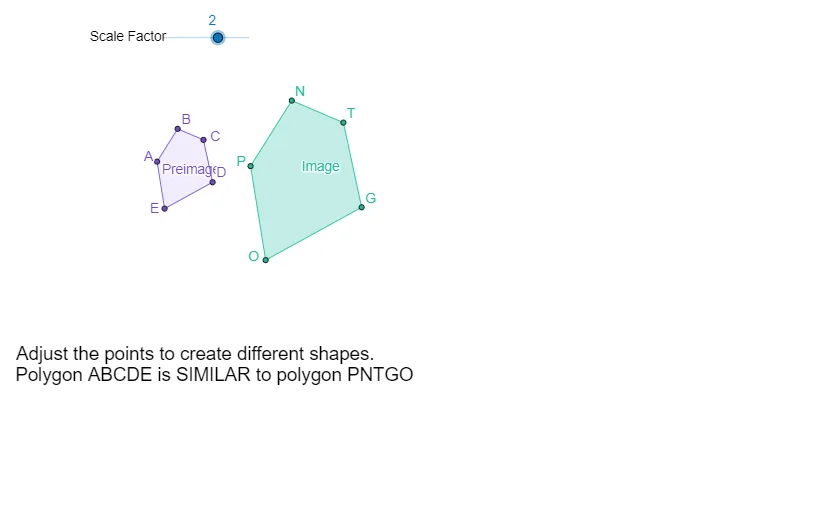
This example demonstrates the concept of similar polygons. Using vector, translation, and dilation commands, similar polygons can be constructed. Suitable for students at the junior high school level and above to learn about similar figures.
GeoGebra Commands & Parameters
Polygon(A, B, C, D, E) → poly1, a, b, c, d_1, eVector(A, F) → uTranslate(A, u) → A'Translate(B, u) → B'Translate(C, u) → C'Translate(D, u) → D'Translate(E, u) → E'Polygon(A', B', C', D', E') → poly1', a', b', c', d', e'Dilate(A', d, G_1) → PDilate(B', d, G_1) → NDilate(C', d, G_1) → TDilate(D', d, G_1) → GDilate(E', d, G_1) → OPolygon(P, N, T, G, O) → poly1'', a'', b'', c'', d'', e''
AI Drawing Prompt Reference
Draw two similar pentagons. First, create a pentagon using points A, B, C, D, and E. Then, create a vector u through point A and translate points A, B, C, D, and E to A', B', C', D', and E' respectively along vector u. Next, use point A' as the center and point G_1 as the scaling center to dilate A', B', C', D', and E' to P, N, T, G, and O. Finally, create another pentagon using points P, N, T, G, and O.
The prompt above was compiled from the original drawing commands and is for reference only.