
Short Sunderland Geometric Model: Rotation, Symmetry, and Transformations
Loading the math board and drawing, please wait…
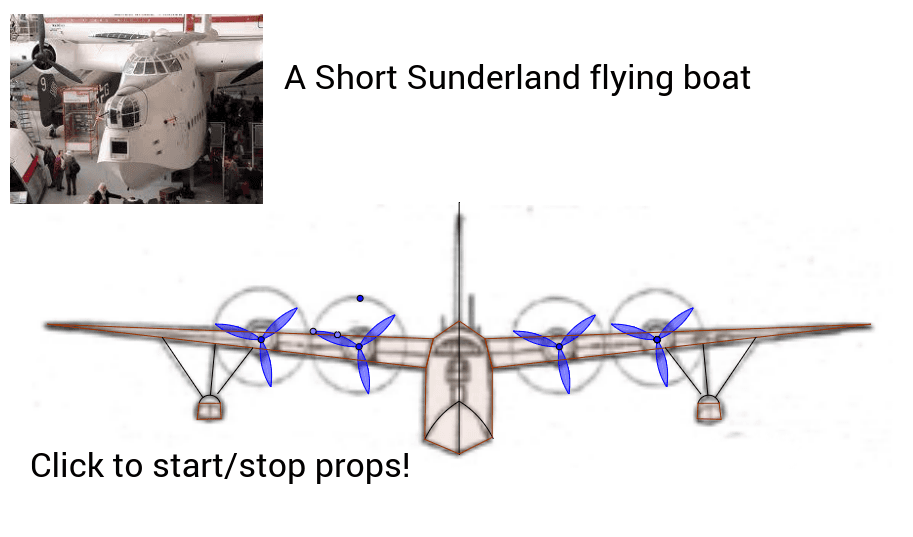
This example uses GeoGebra geometry to build a working model of the Short Sunderland flying boat, demonstrating how points, segments, polygons, circles, and transformations can create a dynamic mechanical illustration. The main mathematical ideas are rotation, reflection, symmetry, translation, vectors, and geometric construction, with supporting use of circumcircle arcs and line bisectors. The construction begins with Point, Segment, and Polygon to define objects such as A, B, C, D, E, F, G, H, I, J, K, L, M, poly1, and poly2. Circle, CircumcircleArc, and LineBisector establish curved and symmetric reference elements, while Mirror, Rotate, Vector, Translate, and Propellor generate transformed parts such as C', D', E', poly1', e', c', d', H', L', K', g', and the propeller motion. The source theme also references limits, random variables, expected value, and statistics, but the visible construction is primarily geometric. It is suitable for secondary geometry, dynamic modeling, transformation lessons, and interactive demonstrations of how GeoGebra commands combine into a working figure.
GeoGebra Commands & Parameters
Polygon(C, D, E) → poly1, e, c, dSegment(F, G) → aMirror(C, a) → C'Mirror(D, a) → D'Mirror(E, a) → E'Polygon(C', D', E') → poly1', e', c', d'Point(a) → IPolygon(F, H, C, E, I, E', C', J) → poly2, f, h, c_1, e_1, i, e'_1, c'_1, jPoint(a) → KCircumcircleArc(H, L, K) → gMirror(H, a) → H'Mirror(L, a) → L'Mirror(K, a) → K'CircumcircleArc(H', L', K') → g'Polygon(M, N, O, P) → poly3, m, n, o, pCircumcircleArc(P, Q, O) → kMirror(M, a) → M'Mirror(N, a) → N'Mirror(O, a) → O'Mirror(P, a) → P'Polygon(M', N', O', P') → poly3', m', n', o', p'Mirror(P, a) → P'_1Mirror(Q, a) → Q'Mirror(O, a) → O'_1CircumcircleArc(P'_1, Q', O'_1) → k'Point(e) → RPoint(k) → SSegment(R, S) → bSegment(U, V) → lSegment(W, Z) → qMirror(F, l) → F'Mirror(R, a) → R'Mirror(S, a) → S'Segment(R', S') → b'Mirror(U, a) → U'Mirror(V, a) → V'Segment(U', V') → l'Mirror(W, a) → W'Mirror(Z, a) → Z'Segment(W', Z') → q'Circle(A_1, B_1) → rPoint(r) → C_1Segment(A_1, C_1) → sLineBisector(s) → tPoint(t) → D_1CircumcircleArc(C_1, D_1, A_1) → d_1Mirror(C_1, s) → E_1Mirror(D_1, s) → F_1Mirror(A_1, s) → G_1CircumcircleArc(E_1, F_1, G_1) → f_1Rotate(A_1, 240*°, A_1) → H_1Rotate(C_1, 240*°, A_1) → I_1Segment(H_1, I_1) → s'Rotate(H_1, 240*°, A_1) → J_1Rotate(I_1, 240*°, A_1) → K_1Segment(J_1, K_1) → s''Rotate(C_1, 240*°, A_1) → L_1Rotate(D_1, 240*°, A_1) → M_1Rotate(A_1, 240*°, A_1) → N_1CircumcircleArc(L_1, M_1, N_1) → g_1Rotate(E_1, 240*°, A_1) → O_1Rotate(F_1, 240*°, A_1) → P_1Rotate(G_1, 240*°, A_1) → Q_1CircumcircleArc(O_1, P_1, Q_1) → h_1Rotate(O_1, 240*°, A_1) → R_1Rotate(P_1, 240*°, A_1) → S_1Rotate(Q_1, 240*°, A_1) → T_1CircumcircleArc(R_1, S_1, T_1) → k_1Rotate(L_1, 240*°, A_1) → U_1Rotate(M_1, 240*°, A_1) → V_1Rotate(N_1, 240*°, A_1) → W_1CircumcircleArc(U_1, V_1, W_1) → p_1Vector(A_1, T) → uTranslate(B_1, u) → Z_1Translate(C_1, u) → A_2Translate(D_1, u) → B_2Propellor(T, Z_1, A_2, B_2) → q_1, r_1, s_1, t_1, c_2, d_2Mirror(A_1, a) → C_2Mirror(T, a) → T'Vector(A_1, C_2) → vVector(C_2, T') → wTranslate(B_1, v) → D_2Translate(C_1, v) → E_2Translate(D_1, v) → F_2Translate(C_1, v) → G_2Translate(D_1, v) → H_2Translate(A_1, v) → I_2CircumcircleArc(G_2, H_2, I_2) → e_2Translate(E_1, v) → J_2Translate(F_1, v) → K_2Translate(G_1, v) → L_2CircumcircleArc(J_2, K_2, L_2) → f_2Translate(R_1, v) → M_2Translate(S_1, v) → N_2Translate(T_1, v) → O_2CircumcircleArc(M_2, N_2, O_2) → g_2Translate(U_1, v) → P_2Translate(V_1, v) → Q_2Translate(W_1, v) → R_2CircumcircleArc(P_2, Q_2, R_2) → h_2Translate(L_1, v) → S_2Translate(M_1, v) → T_2Translate(N_1, v) → U_2CircumcircleArc(S_2, T_2, U_2) → k_2Translate(O_1, v) → V_2Translate(P_1, v) → W_2Translate(Q_1, v) → Z_2CircumcircleArc(V_2, W_2, Z_2) → p_2Translate(G_2, w) → A_3Translate(H_2, w) → B_3Translate(I_2, w) → C_3CircumcircleArc(A_3, B_3, C_3) → q_2Translate(J_2, w) → D_3Translate(K_2, w) → E_3Translate(L_2, w) → F_3CircumcircleArc(D_3, E_3, F_3) → r_2Translate(P_2, w) → G_3Translate(Q_2, w) → H_3Translate(R_2, w) → I_3CircumcircleArc(G_3, H_3, I_3) → s_2Translate(M_2, w) → J_3Translate(N_2, w) → K_3Translate(O_2, w) → L_3CircumcircleArc(J_3, K_3, L_3) → t_2Translate(S_2, w) → M_3Translate(T_2, w) → N_3Translate(U_2, w) → O_3CircumcircleArc(M_3, N_3, O_3) → c_3Translate(V_2, w) → P_3Translate(W_2, w) → Q_3Translate(Z_2, w) → R_3CircumcircleArc(P_3, Q_3, R_3) → d_3
AI Drawing Prompt Reference
Draw a Short Sunderland flying boat geometric model. Start by drawing polygon CDE, then draw segment FG. Mirror C, D, E about FG to get C', D', E', and draw polygon C'D'E'. Next, draw segment FI and mirror H, L, K about FI to get H', L', K', and draw arc HKL and arc H'K'L'. Continue by drawing polygon MNO, then mirror M, N, O, P about MN to get M', N', O', P', and draw arc PQO and arc P'Q'O'. Draw segment RS and mirror F, R, S about RS to get F', R', S', then draw segment UV and segment WZ, mirror U, V about UV to get U', V', and mirror W, Z about WZ to get W', Z'. Finally, draw circle A1B1 and mirror C1, D1 about A1B1 to get E1, F1.
The prompt above was compiled from the original drawing commands and is for reference only.