
Set Intersection Demonstration
Loading the math board and drawing, please wait…
In collections
CCSS Support Math II Unit 4
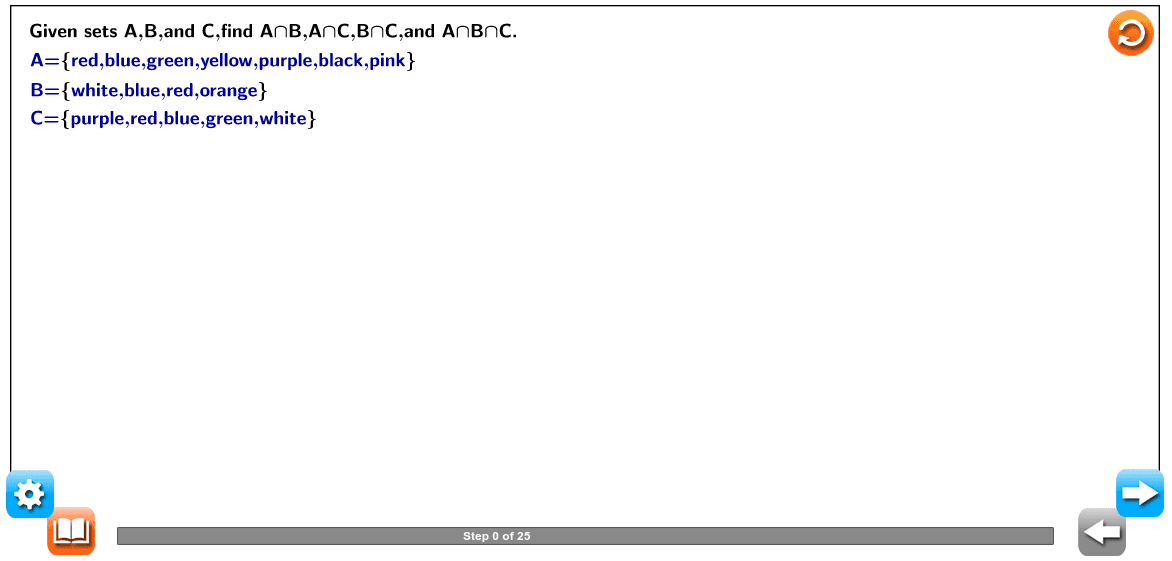
This example demonstrates the visualization of intersection operations and results for three sets A, B, and C. It involves core mathematical concepts such as set intersection and intersection operations. The construction utilizes GeoGebra commands/objects like Intersection, Length, and LaTeX. Suitable for high school students learning and understanding set operations and intersection concepts in three-dimensional space.
GeoGebra Commands & Parameters
Intersection(Acolour, Bcolour) → ABIntersection(Acolour, Ccolour) → ACIntersection(Bcolour, Ccolour) → BCLength(AB) → lengthABIntersection(AB, Ccolour) → ABCLength(AC) → lengthACLength(BC) → lengthBCLength(ABC) → lengthABCLaTeX((("\text{Set \textcolor{#000099}{A} contains the elements \textcolor{#000099}{" * Aout) * "}.}")) → text8LaTeX((("\text{Set \textcolor{#000099}{B} contains the elements \textcolor{#000099}{" * Bout) * "}.}")) → text9LaTeX((("\text{The elements that are in both Set \textcolor{#000099}{A} and Set \textcolor{#000099}{B} are \textcolor{#000099}{" * IntersectionAB) * "}.}")) → text10LaTeX((("\text{Set \textcolor{#000099}{C} contains the elements \textcolor{#000099}{" * Cout) * "}.}")) → text18LaTeX((("\text{The elements that are in both Set \textcolor{#000099}{A} and Set \textcolor{#000099}{C} are \textcolor{#000099}{" * IntersectionAC) * "}.}")) → text19LaTeX("\text{Find A∩C.}") → text6LaTeX("\text{Find B∩C.}") → text16LaTeX((("\text{Set \textcolor{#000099}{B} contains the elements \textcolor{#000099}{" * Bout) * "}.}")) → text22LaTeX((("\text{The elements that are in both Set \textcolor{#000099}{B} and Set \textcolor{#000099}{C} are \textcolor{#000099}{" * IntersectionBC) * "}.}")) → text23LaTeX("\text{Find A∩B∩C.}") → text25LaTeX("\text{To find A∩B∩C,find the elements that are in all three sets.}") → text26LaTeX((("\text{Set \textcolor{#000099}{B} contains the elements \textcolor{#000099}{" * Bout) * "}.}")) → text27LaTeX((("\text{Set \textcolor{#000099}{C} contains the elements \textcolor{#000099}{" * Cout) * "}.}")) → text28LaTeX((("\text{The elements that are in all three sets are \textcolor{#000099}{" * IntersectionABC) * "}.}")) → text29LaTeX("\text{that indicates how likely an event is to occur.}") → text13LaTeX("\text{Find A∩B.}") → text5LaTeX("\text{To find A∩B,find the elements that are in both Set \textcolor{#000099}{A} and Set \textcolor{#000099}{B}.}") → text7LaTeX("\text{To find A∩C,find the elements that are in both Set \textcolor{#000099}{A} and Set \textcolor{#000099}{C}.}") → text17LaTeX("\text{To find B∩C,find the elements that are in both Set \textcolor{#000099}{B} and Set \textcolor{#000099}{C}.}") → text21LaTeX((("\text{Number of colors in Set A=" * ValA) * "}")) → text14LaTeX((("\text{Number of colors in Set B=" * ValB) * "}")) → text15LaTeX((("\text{Number of colors in Set C=" * ValC) * "}")) → text31LaTeX("\text{Given sets A,B,and C,find A∩B,A∩C,B∩C,and A∩B∩C.}") → text1LaTeX((("\text{\mathbf{\textcolor{#000099}{A=}\left\{\textcolor{#000099}{" * Aout) * "}\right\}}}")) → text2LaTeX((("\text{\mathbf{\textcolor{#000099}{B=}\left\{\textcolor{#000099}{" * Bout) * "}\right\}}}")) → text3LaTeX((("\text{\mathbf{\textcolor{#000099}{C=}\left\{\textcolor{#000099}{" * Cout) * "}\right\}}}")) → text4LaTeX((("\text{Therefore,A∩B=\left\{\textcolor{#000099}{" * IntersectionAB) * "}\right\}.}")) → text11LaTeX((("\text{Therefore,A∩C=\left\{\textcolor{#000099}{" * IntersectionAC) * "}\right\}.}")) → text20LaTeX((("\text{Therefore,B∩C=\left\{\textcolor{#000099}{" * IntersectionBC) * "}\right\}.}")) → text24LaTeX((("\text{Therefore,A∩B∩C=\left\{\textcolor{#000099}{" * IntersectionABC) * "}\right\}.}")) → text30LaTeX("\text{\mathbf{Probability} a number from \textcolor{#000099}0 to \textcolor{#000099}1 inclusive or a percent from \textcolor{#000099}{0%} to \textcolor{#000099}{100%} inclusive}") → text12
AI Drawing Prompt Reference
Draw three sets in three-dimensional space, colored differently, and show their intersections. First find the intersections of two sets and represent them with lines, then find the intersection of all three sets and also represent it with lines. Measure and label the lengths of each intersection, and use text to describe the elements of each set and the results of the intersections. The final image should include the sets, intersection lines, length labels, and explanatory text, clearly demonstrating the results of set operations.
The prompt above was compiled from the original drawing commands and is for reference only.