
Segment Bisector Definition
Loading the math board and drawing, please wait…
In collections
Congruence (CO) Cluster
CCSS High School: Geometry (Congruence) Volume 1
CCSS High School: Geometry (Congruence) Volume 1
CCSS High School: Geometry (Congruence) Volume 1
Points, Lines, Planes, and Angles
Points, Lines, Planes, and Angles
Congruence: Volume 1 - Chapter 1
Congruence: Volume 1 - Chapter 1
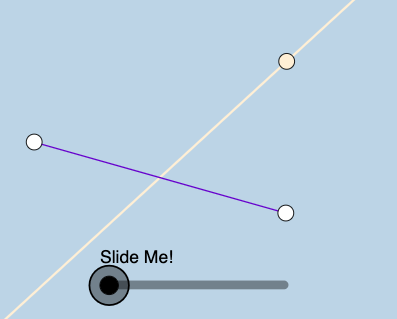
This example illustrates the definition of a segment bisector. Key mathematical concepts include segments, midpoints, and lines. Using GeoGebra commands such as Segment, Midpoint, and Line, the construction of a segment bisector is demonstrated. Suitable for middle school geometry education.
GeoGebra Commands & Parameters
Segment(A, B) → fMidpoint(f) → CSegment(A, C) → gSegment(C, B) → hLine(C, D) → iSegment(A, C) → jRotate(A, If[0.5 < a ≤ 1.5, ((-(a - 0.5)) * pi), (-pi)], C) → A'Rotate(C, If[0.5 < a ≤ 1.5, ((-(a - 0.5)) * pi), (-pi)], C) → C'Segment(A', C') → j'
AI Drawing Prompt Reference
Draw a segment and mark its midpoint. Connect one endpoint to the midpoint and the other endpoint to the midpoint, creating two equal sub-segments. Then, draw a line through the midpoint that intersects the segment at the midpoint, serving as the perpendicular bisector. Finally, take a point on this line, connect it to the midpoint, and rotate this connecting segment around the midpoint by an angle, so the rotated segment is symmetric to the original about the midpoint, illustrating the definition of a segment bisector.
The prompt above was compiled from the original drawing commands and is for reference only.