
Sean Jackson Constructions Example by scjackson (2)
Loading the math board and drawing, please wait…
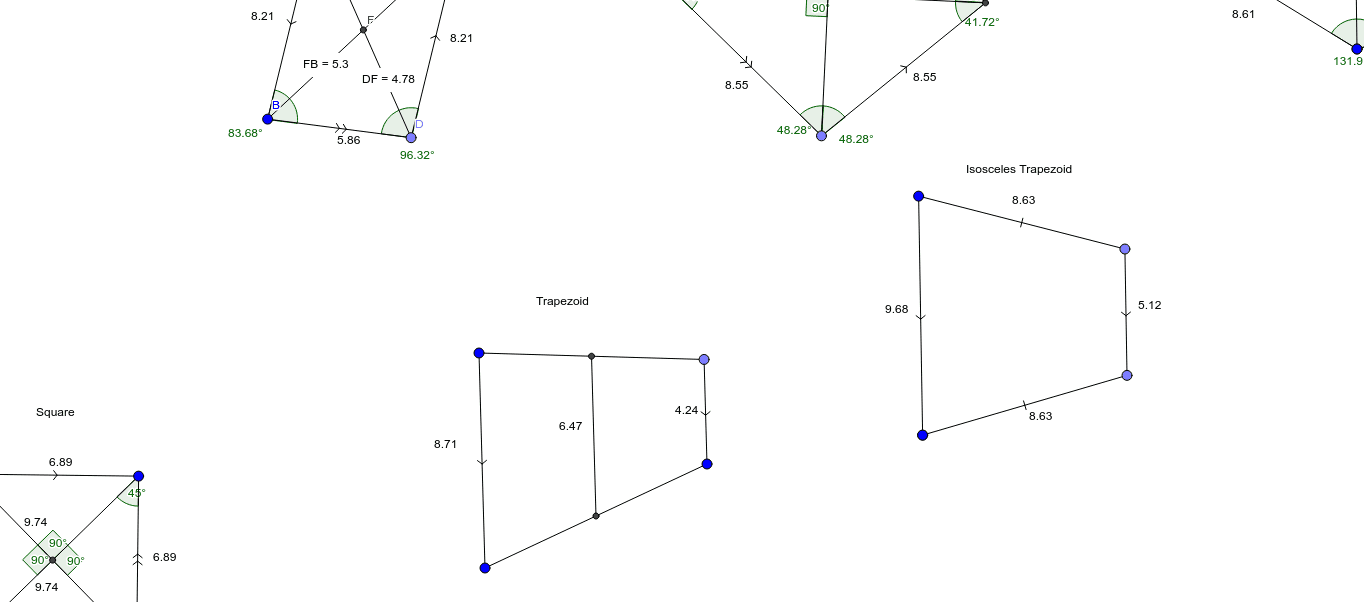
This example demonstrates geometric constructions using fundamental elements like points, lines, and angles. It involves core math concepts including geometric construction, probability & statistics, real numbers, and solid geometry. GeoGebra commands and objects such as Segment, Line, Point, Intersect, Angle, Distance, Circle, OrthogonalLine, Midpoint, Mirror are used in the construction process. Suitable for high school students and math enthusiasts learning geometric construction methods and probability knowledge.
GeoGebra Commands & Parameters
Segment(A, B) → aLine(C, a) → bPoint(b) → DSegment(B, D) → cLine(A, c) → dIntersect(b, d) → ESegment(D, E) → eSegment(A, E) → fAngle(B, A, E) → αAngle(A, E, D) → βAngle(E, D, B) → γAngle(D, B, A) → δSegment(E, B) → hSegment(A, D) → gIntersect(h, g) → FDistance(A, F) → distanceAFDistance(F, E) → distanceFEDistance(D, F) → distanceDFDistance(F, B) → distanceFBSegment(G, H) → iCircle(G, H) → kPoint(k) → JSegment(G, J) → jCircle(G, H) → qLine(J, i) → lLine(H, j) → mIntersect(l, m) → KSegment(J, K) → nSegment(K, H) → pSegment(H, J) → rSegment(G, K) → sIntersect(r, s) → LAngle(G, L, J) → εAngle(K, J, L) → ζAngle(L, J, G) → ηAngle(J, G, L) → θAngle(L, G, H) → ιAngle(G, H, L) → κAngle(L, H, K) → λAngle(H, K, L) → μAngle(L, K, J) → νSegment(M, N) → tLine(O, t) → a_1OrthogonalLine(N, t) → b_1OrthogonalLine(M, t) → c_1Intersect(a_1, c_1) → PIntersect(a_1, b_1) → QSegment(N, Q) → d_1Segment(Q, P) → e_1Segment(P, M) → f_1Angle(M, N, Q) → ξAngle(N, Q, P) → οAngle(Q, P, M) → ρAngle(P, M, N) → σSegment(N, P) → g_1Segment(Q, M) → h_1Segment(R, S) → i_1Circle(R, S) → k_1OrthogonalLine(R, i_1) → j_1Circle(R, S) → p_1Intersect(p_1, j_1, 1) → TLine(T, i_1) → l_1OrthogonalLine(S, i_1) → m_1Intersect(l_1, m_1) → UIntersect(j_1, l_1) → VSegment(V, R) → n_1Segment(U, S) → q_1Segment(V, U) → r_1Segment(R, U) → s_1Segment(S, V) → t_1Intersect(s_1, t_1) → WAngle(U, W, S) → τAngle(S, W, R) → υAngle(R, W, V) → ϕSegment(Z, A_1) → a_2Line(B_1, a_2) → b_2Point(b_2) → C_1Segment(Z, C_1) → c_2Segment(A_1, B_1) → d_2Segment(C_1, B_1) → e_2Midpoint(c_2) → D_1Midpoint(d_2) → E_1Segment(D_1, E_1) → f_2Segment(F_1, G_1) → g_2Line(H_1, g_2) → h_2Point(h_2) → I_1Segment(F_1, I_1) → i_2Midpoint(g_2) → J_1OrthogonalLine(J_1, g_2) → j_2Mirror(F_1, j_2) → K_1Mirror(I_1, j_2) → L_1Segment(K_1, L_1) → k_2Segment(I_1, L_1) → l_2Segment(P_1, Q_1) → p_2Midpoint(p_2) → R_1OrthogonalLine(R_1, p_2) → q_2Point(q_2) → O_1Segment(P_1, O_1) → n_2Mirror(P_1, q_2) → S_1Mirror(O_1, q_2) → T_1Segment(S_1, T_1) → r_2Point(q_2) → U_1Segment(Q_1, U_1) → s_2Mirror(Q_1, q_2) → V_1Mirror(U_1, q_2) → W_1Segment(V_1, W_1) → t_2Segment(O_1, U_1) → a_3Intersect(p_2, a_3) → Z_1Angle(Q_1, Z_1, O_1) → ψAngle(U_1, P_1, O_1) → χAngle(O_1, Q_1, U_1) → α_1Angle(V, R, S) → ωAngle(S, U, V) → β_1Angle(W, V, R) → γ_1Angle(W, S, U) → δ_1