
Sean Jackson Constructions: Comprehensive Geometric Construction with Segments,
Loading the math board and drawing, please wait…
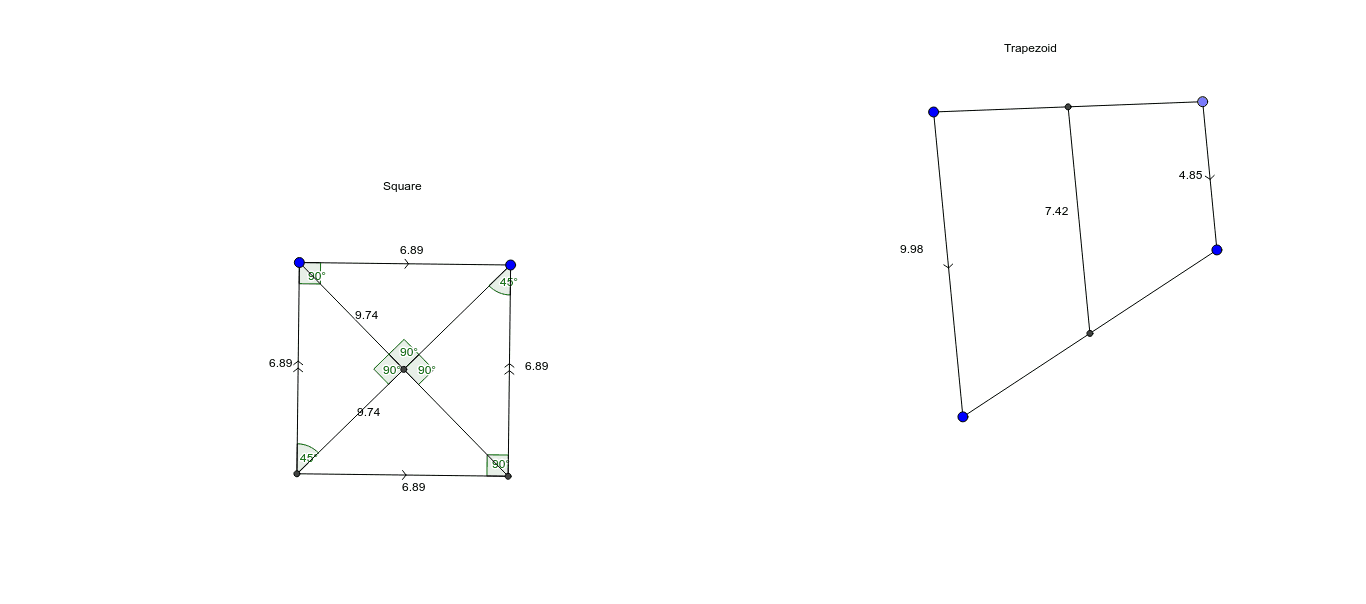
This GeoGebra example presents a complex geometric construction involving points, segments, lines, circles, orthogonal lines, midpoints, and reflections, demonstrating how to build a network of geometric relationships with angle and distance measurements plus text annotations. The core mathematical concepts include Euclidean construction techniques (midpoint, perpendicular, reflection), angle and distance measurement, and potential extensions to linear regression, parametric curves, sine functions, random variables, and spheres. The construction uses GeoGebra commands such as Segment, Line, Point, Intersect, Angle, Distance, Circle, OrthogonalLine, Midpoint, and Mirror, creating numerous objects: points (A, B, C, D, E, F, G, H, I, J, K), segments/lines (a, b, c, d, e, f, h, g, i, j, k, q, l, m, n, p, r), angles (α, β, γ, δ), and distance text labels (distanceAF, TextAF, etc.). Suitable for middle school and above for geometric construction practice, dynamic exploration of properties, or as a teacher demonstration of step-by-step construction.
GeoGebra Commands & Parameters
Segment(A, B) → aLine(C, a) → bPoint(b) → DSegment(B, D) → cLine(A, c) → dIntersect(b, d) → ESegment(D, E) → eSegment(A, E) → fAngle(B, A, E) → αAngle(A, E, D) → βAngle(E, D, B) → γAngle(D, B, A) → δSegment(E, B) → hSegment(A, D) → gIntersect(h, g) → FDistance(A, F) → distanceAFDistance(F, E) → distanceFEDistance(D, F) → distanceDFDistance(F, B) → distanceFBSegment(G, H) → iCircle(G, H) → kPoint(k) → JSegment(G, J) → jCircle(G, H) → qLine(J, i) → lLine(H, j) → mIntersect(l, m) → KSegment(J, K) → nSegment(K, H) → pSegment(H, J) → rSegment(G, K) → sIntersect(r, s) → LAngle(G, L, J) → εAngle(K, J, L) → ζAngle(L, J, G) → ηAngle(J, G, L) → θAngle(L, G, H) → ιAngle(G, H, L) → κAngle(L, H, K) → λAngle(H, K, L) → μAngle(L, K, J) → νSegment(M, N) → tLine(O, t) → a_1OrthogonalLine(N, t) → b_1OrthogonalLine(M, t) → c_1Intersect(a_1, c_1) → PIntersect(a_1, b_1) → QSegment(N, Q) → d_1Segment(Q, P) → e_1Segment(P, M) → f_1Angle(M, N, Q) → ξAngle(N, Q, P) → οAngle(Q, P, M) → ρAngle(P, M, N) → σSegment(N, P) → g_1Segment(Q, M) → h_1Segment(R, S) → i_1Circle(R, S) → k_1OrthogonalLine(R, i_1) → j_1Circle(R, S) → p_1Intersect(p_1, j_1, 1) → TLine(T, i_1) → l_1OrthogonalLine(S, i_1) → m_1Intersect(l_1, m_1) → UIntersect(j_1, l_1) → VSegment(V, R) → n_1Segment(U, S) → q_1Segment(V, U) → r_1Segment(R, U) → s_1Segment(S, V) → t_1Intersect(s_1, t_1) → WAngle(U, W, S) → τAngle(S, W, R) → υAngle(R, W, V) → ϕSegment(Z, A_1) → a_2Line(B_1, a_2) → b_2Point(b_2) → C_1Segment(Z, C_1) → c_2Segment(A_1, B_1) → d_2Segment(C_1, B_1) → e_2Midpoint(c_2) → D_1Midpoint(d_2) → E_1Segment(D_1, E_1) → f_2Segment(F_1, G_1) → g_2Line(H_1, g_2) → h_2Point(h_2) → I_1Segment(F_1, I_1) → i_2Midpoint(g_2) → J_1OrthogonalLine(J_1, g_2) → j_2Mirror(F_1, j_2) → K_1Mirror(I_1, j_2) → L_1Segment(K_1, L_1) → k_2Segment(I_1, L_1) → l_2Segment(P_1, Q_1) → p_2Midpoint(p_2) → R_1OrthogonalLine(R_1, p_2) → q_2Point(q_2) → O_1Segment(P_1, O_1) → n_2Mirror(P_1, q_2) → S_1Mirror(O_1, q_2) → T_1Segment(S_1, T_1) → r_2Point(q_2) → U_1Segment(Q_1, U_1) → s_2Mirror(Q_1, q_2) → V_1Mirror(U_1, q_2) → W_1Segment(V_1, W_1) → t_2Segment(O_1, U_1) → a_3Intersect(p_2, a_3) → Z_1Angle(Q_1, Z_1, O_1) → ψAngle(U_1, P_1, O_1) → χAngle(O_1, Q_1, U_1) → α_1Angle(V, R, S) → ωAngle(S, U, V) → β_1Angle(W, V, R) → γ_1Angle(W, S, U) → δ_1Segment(F_1, L_1) → b_3Segment(I_1, G_1) → c_3