
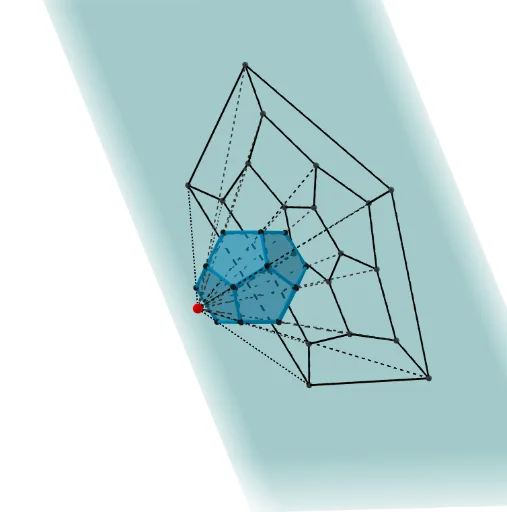
Schlegel Diagram of Dodecahedron
Loading the math board and drawing, please wait…
This example demonstrates the Schlegel diagram of a dodecahedron. A Schlegel diagram is a projection of a polyhedron into a lower dimension, showing its internal structure. Key mathematical concepts include polyhedra, geometric transformations, and projections. Using GeoGebra commands such as Circle, Intersect, and Rotate, the Schlegel diagram of a dodecahedron is constructed. Suitable for high school geometry education and learning.
GeoGebra Commands & Parameters
Circle(OO, 1, xOyPlane) → cIntersect(xAxis, c, 1) → ARotate(A, 60°) → BPoint(Circle[((A * (1 - sqrt(5))) + (B * (3 + sqrt(5)))) / 4, (Distance[A, B] * sqrt(10 + (2 * sqrt(5))) / 4), Segment[A, B]]) → CDodecahedron(A, B, C) → a, D, M, N, O, P, Q, R, S, T, zijvlakABCDE, zijvlakAEIOJ, E, zijvlakABFKJ, zijvlakBCGLF, zijvlakCDHMG, zijvlakDEINH, zijvlakINSTO, zijvlakJKPTO, zijvlakFKPQL, zijvlakGLQRM, zijvlakHMRSN, zijvlakPQRST, F, RibbeAE, RibbeAB, RibbeBC, RibbeCD, RibbeDE, RibbeAJ, RibbeEI, RibbeIO, RibbeJO, RibbeJK, G, RibbeFK, RibbeBF, RibbeFL, RibbeGL, RibbeCG, RibbeGM, RibbeHM, RibbeDH, RibbeHN, RibbeIN, H, RibbeNS, RibbeST, RibbeOT, RibbePT, RibbeKP, RibbePQ, RibbeLQ, RibbeQR, RibbeMR, RibbeRS, I, J, K, LMidpoint(RibbeAB) → USegment(K, U) → fMidpoint(RibbeFK) → VSegment(A, V) → gIntersect(f, g) → WMidpoint(RibbeRS) → ZSegment(H, Z) → hMidpoint(RibbeNS) → A_1Segment(M, A_1) → iMidpoint(i) → WWLine(W, WW) → jPoint(j) → B_1Point(j) → C_1OrthogonalPlane(C_1, j) → bLine(B_1, A) → kLine(B_1, B) → lIntersect(l, k) → D_1Line(B_1, F) → mLine(B_1, K) → nLine(B_1, J) → pIntersect(p, b) → E_1Intersect(n, b) → F_1Intersect(m, b) → G_1Intersect(l, b) → H_1Intersect(k, b) → I_1Polygon(I_1, H_1, G_1, F_1, E_1) → veelhoek1, i_1, h_1, g_1, f_1, e_1Segment(B_1, E_1) → qSegment(B_1, F_1) → rSegment(B_1, G_1) → sSegment(B_1, H_1) → tSegment(B_1, I_1) → dLine(B_1, P) → eLine(B_1, Q) → j_1Intersect(e, b) → J_1Intersect(j_1, b) → K_1Segment(B_1, J_1) → l_1Segment(B_1, K_1) → m_1Intersect(RibbeJO, RibbeIO) → L_1Line(B_1, L_1) → n_1Line(B_1, T) → p_1Intersect(n_1, b) → M_1Intersect(p_1, b) → N_1Polygon(E_1, M_1, N_1, J_1, F_1) → veelhoek2, e_2, m_2, n_2, j_3, f_3Line(B_1, L) → k_1Intersect(k_1, b) → O_1Polygon(F_1, J_1, K_1, O_1, G_1) → veelhoek3, f_2, j_2, k_2, o_1, g_2Segment(B_1, M_1) → q_1Segment(B_1, N_1) → r_1Segment(B_1, O_1) → s_1Line(B_1, G) → t_1Line(B_1, C) → a_1Intersect(t_1, b) → P_1Intersect(a_1, b) → Q_1Polygon(G_1, O_1, P_1, Q_1, H_1) → veelhoek4, g_3, o_2, p_2, q_2, h_2Intersect(a_1, t_1) → R_1Line(B_1, E) → b_1Intersect(t_1, a_1) → S_1Line(B_1, D) → c_1Line(B_1, I) → d_1Intersect(d_1, b) → T_1Intersect(b_1, b) → U_1Segment(B_1, P_1) → i_2Intersect(c_1, b_1) → V_1Segment(B_1, Q_1) → l_2Segment(B_1, T_1) → r_2Segment(B_1, U_1) → s_2Polygon(I_1, U_1, T_1, M_1, E_1) → veelhoek5, i_3, u_1, t_2, m_3, e_3Line(B_1, H) → a_2Line(B_1, M) → b_2Intersect(b_2, b) → W_1Intersect(c_1, b) → Z_1Intersect(a_2, b) → A_2Polygon(I_1, H_1, Q_1, Z_1, U_1) → veelhoek6, i_4, h_3, q_3, z_1, u_2Segment(B_1, A_2) → c_2Line(B_1, D) → d_2Segment(B_1, Z_1) → k_3Line(B_1, N) → l_3Intersect(l_3, b) → B_2Segment(B_1, B_2) → n_3Segment(B_1, A_2) → p_3Segment(B_1, W_1) → r_3Polygon(T_1, U_1, Z_1, A_2, B_2) → veelhoek7, t_3, u_3, z_2, a_3, b_3Polygon(Z_1, Q_1, P_1, W_1, A_2) → veelhoek8, z_3, q_4, p_4, w_1, a_4Line(B_1, S) → s_3Intersect(s_3, b) → C_2Segment(B_1, C_2) → c_3Polygon(M_1, T_1, B_2, C_2, N_1) → veelhoek9, m_4, t_4, b_4, c_4, n_4Line(B_1, R) → d_3Intersect(d_3, b) → D_2Segment(B_1, D_2) → f_4Segment(C_2, D_2) → g_4Segment(K_1, D_2) → h_4Segment(D_2, W_1) → j_4