
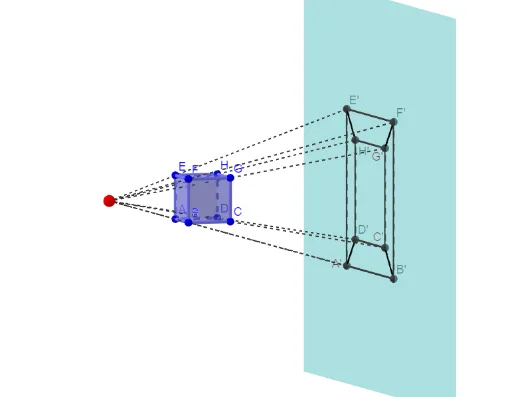
Schlegel Diagram of a Hexahedron (Cube) in 3D Projection
Loading the math board and drawing, please wait…
In collections
Solids, graphs and paths
① This GeoGebra example demonstrates the Schlegel diagram of a cube (hexahedron), which is a perspective projection of the 3D polyhedron onto a 2D plane, showing its wireframe structure and topological connectivity. ② Core mathematical concepts include solid geometry, polyhedral projection, perspective drawing, and the Schlegel diagram as a representation of convex polytopes in lower dimensions. ③ Construction details: The cube is created using the Cube command; points, lines, intersections, polygons, and segments are generated via Point, Line, Intersect, Polygon, and Segment commands. Objects include the six faces (e.g., zijvlakABCD) and twelve edges (e.g., RibbeAD) of the cube, along with auxiliary points I, J, K, L and segments b, f, g, etc., to build the projected framework. ④ Suitable for high school or early university students studying solid geometry, topology, or computer graphics, and useful for mathematical visualization to understand how higher-dimensional objects are represented in lower dimensions.
GeoGebra Commands & Parameters
Point(Circle[B, Distance[A, B], Segment[A, B]]) → CCube(A, B, C) → a, D, zijvlakCDHG, zijvlakEFGH, RibbeAD, RibbeAB, RibbeBC, RibbeCD, RibbeAE, RibbeDH, RibbeEH, RibbeEF, E, RibbeBF, RibbeFG, RibbeCG, RibbeGH, F, G, H, zijvlakABCD, zijvlakADHE, zijvlakABFE, zijvlakBCGFPoint(xAxis) → ILine(I, A) → fLine(I, B) → gLine(I, C) → hLine(I, D) → iLine(I, E) → jLine(I, F) → kLine(I, G) → lLine(I, H) → mIntersect(j, b) → JIntersect(m, b) → KIntersect(k, b) → LIntersect(l, b) → MIntersect(i, b) → NIntersect(f, b) → OIntersect(h, b) → PIntersect(g, b) → QPolygon(O, Q, L, J) → vierhoek1, o, q, l_1, j_1Polygon(M, K, N, P) → vierhoek2, m_1, k_1, n, pSegment(I, J) → rSegment(I, K) → sSegment(I, L) → tSegment(I, M) → cSegment(I, O) → dSegment(I, N) → eSegment(I, P) → f_1Segment(I, Q) → g_1Segment(J, K) → h_1Segment(M, L) → i_1Segment(P, Q) → n_1Segment(N, O) → p_1
AI Drawing Prompt Reference
Draw a Schlegel diagram of a cube, including six faces (like ABCD), twelve edges (like AD), and auxiliary points I and eight lines from I (like IJ), forming two quadrilaterals (like IJKL).
The prompt above was compiled from the original drawing commands and is for reference only.