
SAS Theorem Exercise 3: Proving Triangles Congruent
Loading the math board and drawing, please wait…
In collections
Congruence (CO) Cluster
Congruence (Vol 1)
Congruence (Vol 1) Over 80 Resources
Geometry (Congruence) Volume 1
CCSS High School: Geometry (Congruence) Volume 1 S N ATTAR
CCSS High School: Geometry (Congruence) Volume 1
CCSS High School: Geometry (Congruence) Volume 1
CCSS High School: Geometry (Congruence) Volume 1
CCSS High School: Geometry (Congruence) Volume 1
CCSS High School: Geometry (Congruence) Volume 1
CCSS High School: Geometry (Congruence) Volume 1
CCSS High School: Geometry (Congruence) Volume 1
CCSS High School: Geometry (Congruence) Volume 1
CCSS High School: Geometry (Congruence) Volume 1
CCSS High School: Geometry (Congruence) Volume 1
CCSS High School: Geometry (Congruence) Volume 1
Unit 5: Triangle Congruence
Triangle Congruence Theorems 1
Triangle Congruence Book 1
Proving Triangles Congruent
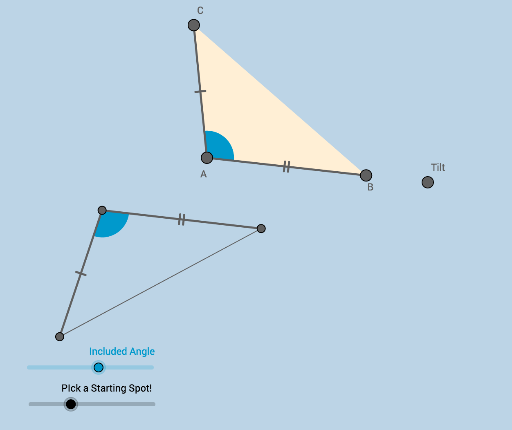
This example demonstrates how to prove triangles congruent using the SAS theorem. Key math concepts include triangle congruence and transformational geometry. It uses GeoGebra commands such as Ray, Rotate, Polygon, etc., for geometric construction. Suitable for middle school and above students to learn triangle congruence proof methods.
GeoGebra Commands & Parameters
Ray(A, B_1) → fRotate(B_1, α, A) → B'Angle(B_1, A, B') → βPoint(f) → BRay(A, B') → gPoint(g) → CPolygon(A, B, C) → poly1, h, i, jSegment(A, C) → kSegment(A, B) → lCircle(A, (0.2 * Min[k, l])) → cIntersect(c, f) → F,Intersect(c, k) → G,CircleSector(A, F, G) → dPoint(xAxis) → HVector(H, I) → uTranslate(A, u) → A'Translate(C, u) → D'Segment(A', D') → k'Translate(A, u) → A'_1Translate(B, u) → C'Translate(C, u) → D'_1Polygon(A'_1, C', D'_1) → poly1', d'_1, a'_1, c'Segment(D'_1, A'_1) → mSegment(C', A'_1) → nSegment(D'_1, C') → pCircle(A'_1, Radius[c]) → eIntersect(e, n, 1) → JIntersect(e, m, 1) → KCircleSector(A'_1, J, K) → qLine(L, M) → rMirror(A'_1, r) → NMirror(C', r) → C''Mirror(D'_1, r) → OPolygon(N, C'', O) → poly1'', o, n_1, c''Mirror(q, r) → q'Rotate(N, γ, P) → N'Rotate(C'', γ, P) → C'''Rotate(O, γ, P) → O'Polygon(N', C''', O') → poly1''', o', n', c'''Rotate(q', γ, P) → q''Segment(N', O') → sSegment(N', C''') → tSegment(O', C''') → a