
Runner Model for Multiplication of Directed Numbers
Loading the math board and drawing, please wait…
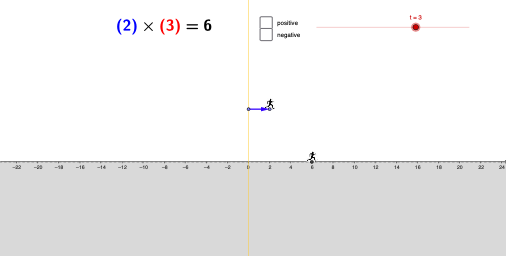
① This example uses a dynamic “runner” model to visually demonstrate the geometric meaning of multiplying directed (signed) numbers. ② Core mathematical concepts include the sign rules for directed‑number multiplication, scalar multiplication and translation of vectors, representation of directed segments on the coordinate plane, and sequence‑driven discrete animation. ③ Construction highlights: Points, Segments, and Vectors are created with Point, Segment, Vector; Translate applies vector translations; Sequence generates a series of translated objects to form the animation; the objects a, B, b, C, c, pic1, u, d, e, s, t, D, E, F, p, G, v, pic1', text1, f, list1, list2 together build the interactive scene. ④ Suitable for middle‑school (grades 7‑9) lessons on signed‑number multiplication, and as an introductory demo for high‑school vector and coordinate geometry, useful for teacher presentations or student self‑exploration.
GeoGebra Commands & Parameters
Point(a) → BPoint(b) → CSegment(B, C) → cVector(B, C) → uVector(C, G) → vTranslate(pic1, v) → pic1'Sequence(x = (k * s), k, 1, 10) → list1Sequence(x = (k * s), k, -10, -1) → list2
AI Drawing Prompt Reference
Draw a graphic to demonstrate the rules of multiplying signed numbers. Include points, line segments, and vectors. For example, a line segment and vector from point B to point C, and a vector from point C to point G. Also include an object translated by vector v. A sequence can generate a series of translated objects to form an animation. The overall graphic should clearly show these elements and their relationships, suitable for teaching demonstrations.
The prompt above was compiled from the original drawing commands and is for reference only.