
Rounding Mixed Numbers to the Nearest Whole Number via Number-Line Drops
Loading the math board and drawing, please wait…
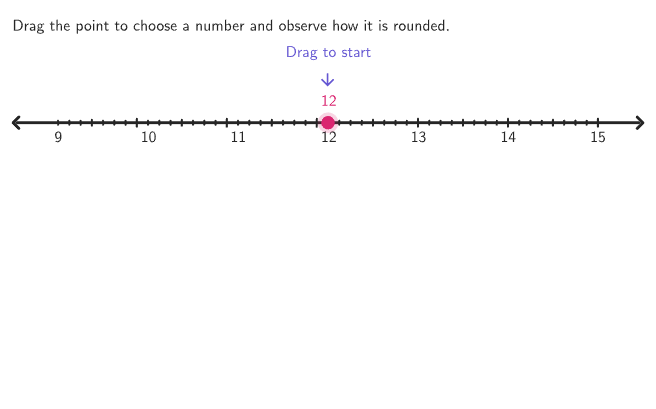
This GeoGebra example demonstrates how to round mixed numbers to the nearest whole number using an interactive number-line “ball drop” simulation, where the rounded value is determined by where the ball lands. It centers on number sense and rounding rules, including deciding whether a fraction/mixed number should round up or down to the closest integer. Construction-wise, it uses RandomUniform to generate trials and random number-line positions, Take and Sequence to structure random partitions, and If to implement the rounding decision logic that produces the computed answerValue. Pixel-to-geometry mapping is handled with PixelsToPoint and PointToPixels, while Points, Segments, PolyLine, Translate, circlePixels, and Text create the ball path, landing point, and on-screen labels. Intersect, Element, Min, Join, and Flatten support geometric relationships and layout, alongside interface elements like PStudentA/PStudentB/PAnswer and studentLatex for student responses, plus animation controls such as animateControl/showsolution. Suitable for elementary grades (e.g., 4–5) and as a classroom exploration or formative assessment on rounding decimals and fractions/mixed numbers.
GeoGebra Commands & Parameters
RandomUniform(0, 0.99, 200) → allRandomSeeds, {0.5668871785313813, 0.7878350905067724, 0.9311749321675805, 0.0175552890019373, 0.4235791510343603, 0.8810211530632253, 0.44479989238133766, 0.005494241368659121, 0.9855997677245458, 0.3441860723946548, 0.32692100739060653, 0.42073650918539374, 0.6188569982433251, 0.6461909875519973, 0.9676818893133057, 0.7710544011563278, 0.8544238819166017, 0.8266241070769975, 0.04037384907933877, 0.5391275648258061, 0.45971422694806535, 0.7348953497211972, 0.4891168903272315, 0.5480423668055799, 0.8848932037277466, 0.5200330522841385, 0.8880052256528849, 0.7696593869090032, 0.31310273708971254, 0.5069286396871207, 0.9335932073188407, 0.8351642212084114, 0.6386579183637495, 0.1352726298898554, 0.83989235140512, 0.59808279823722, 0.8138840817618966, 0.3463610267805037, 0.1282832017362658, 0.8544477533351373, 0.13271603396304194, 0.9803245656560545, 0.8339144133581957, 0.9226430954029441, 0.037568712346347614, 0.9121433414529065, 0.40527054732863177, 0.026734509685807338, 0.6553153151198451, 0.3490575742060954, 0.7446334337191258, 0.6418092487154681, 0.8684724680195457, 0.6446709854631356, 0.5541453903519571, 0.9780034678279456, 0.5888931671979778, 0.12616610475118817, 0.17510197981386535, 0.10148727141089212, 0.7234067713361823, 0.7206112687629955, 0.7669598250618354, 0.055706497409587025, 0.10392179798588214, 0.30433758975654157, 0.17733942569310665, 0.4846474754380056, 0.3885204114895964, 0.16579902775419475, 0.9650358404716982, 0.10179499586068998, 0.12502560337554813, 0.8372025883703903, 0.27471955019897426, 0.35379557083490376, 0.6644094285874771, 0.7135051767461653, 0.8646177800263095, 0.28661765026572616, 0.02823817000054731, 0.8491228544694973, 0.2570109470285234, 0.7042168170396051, 0.31211291415831927, 0.6528827743718506, 0.4858616250668642, 0.22536863148370598, 0.7557659226526792, 0.31037177277678124, 0.6263132454893933, 0.43342336755140093, 0.13011138137234385, 0.7198956624753389, 0.05715328388276045, 0.4062663268960118, 0.4821256397627214, 0.6237619789984971, 0.7696304625859507, 0.0197342154402179, 0.4199453062862046, 0.7805336617663351, 0.4942479685681018, 0.017142028499418187, 0.9030232261924495, 0.8162747918384896, 0.121324551515946, 0.7604175344452105, 0.13557070750135886, 0.9536198759523614, 0.9312230553841659, 0.43461836555345473, 0.8858405314350066, 0.13674617694797572, 0.8961905188485416, 0.037325155083231434, 0.31906924015215304, 0.27801409601975324, 0.9177364002047752, 0.11755706814921295, 0.008097860633408687, 0.2881638927965987, 0.33139593205326884, 0.15544863858502886, 0.812829678989576, 0.1365172736644327, 0.29458232034393506, 0.5539559910541718, 0.10775891488173604, 0.7706305754035851, 0.22302669859992916, 0.03732694624243841, 0.2758184066221511, 0.0962818890399786, 0.89703766428324, 0.5879746965332273, 0.1467457713384284, 0.8585473455300753, 0.41048117856329636, 0.6837351301040444, 0.869055435004406, 0.8030325253533166, 0.6229898634271944, 0.26126879841526895, 0.726530794513803, 0.2030727469039789, 0.5294552716883392, 0.11858391720930554, 0.4129140114228028, 0.10390177789461688, 0.3503392620106768, 0.900312137447168, 0.19217265407279976, 0.1984115621980557, 0.9417602384307504, 0.3134597386918916, 0.6063601379155485, 0.5011857436470489, 0.8756680544751102, 0.30888708609349386, 0.14866407074647797, 0.5779883669650946, 0.9277155492529916, 0.32473503906185325, 0.7457498119657, 0.7468241821826066, 0.953667706001302, 0.9824222077213942, 0.8409576764532649, 0.8040603608748161, 0.39435907489624566, 0.6136782325955016, 0.08830092961819246, 0.07490976363937456, 0.8343173994216834, 0.008357251157739118, 0.7565381486769427, 0.22182416680665318, 0.7102167717630666, 0.2074936068353299, 0.5728569138766492, 0.2570311478109328, 0.10230542108028912, 0.8442149047119832, 0.2069069093133991, 0.10657148381854802, 0.5248738579599038, 0.28672009018829275, 0.8680595922405125, 0.8127547158273835, 0.6506858002048873, 0.2925593422843709, 0.9718472161097647, 0.08994796737470599, 0.49908993655335254, 0.31191922050515086, 0.6855482165886332, 0.775049425543932, 0.12826240202651681, 0.26952094877256405}Take(allRandomSeeds, randIndex, randIndex + numRandoms - 1) → currentRandomSeedsIf(countQuestion ≟ 0, 10, Element[{7, 8, 9, 10}, 1 + floor((currentRandomSeeds(2) * 4))]) → randomDivisionsPixelsToPoint((xMin, yMin), (xMax, yMax), (PXwidth, PXheight), (784, 150)) → AnchorRightPixelsToPoint((xMin, yMin), (xMax, yMax), (PXwidth, PXheight), (16, 150)) → AnchorLeftSequence(AnchorLeft + ((A * unitIncrement) + unitIncrement / 2, 0), A, 0, 6) → allUnitPositionsPolyLine(Flatten[Zip[{A + (0.75 * vLine2), A + (unitIncrement / 2, 0) + (0.45 * vLine2), A + (unitIncrement, 0) + (0.75 * vLine2)}, A, Take[allUnitPositions, 1, 6]]]) → zigZagFlatten(Append[Zip[Sequence[B + ((A * tickIncrement), 0), A, 0, randomDivisions - 1], B, Take[allUnitPositions, 1, 6]], allUnitPositions(-1)]) → allTicksInOrderJoin({Take[allTicksInOrder, IndexOf[allUnitPositions(4), allTicksInOrder]], Take[allTicksInOrder, 1, IndexOf[allUnitPositions(4), allTicksInOrder] - 1]}) → allTickPositionsPoint(allTickPositions) → PStudentATranslate(ClosestPoint[allUnitPositions, PStudentA + (0.00001, 0)], vLine2) → PAnswerIf(countQuestion ≟ 1, Element[{2, 6}, 1 + floor((currentRandomSeeds(4) * 2))], 2 + floor((currentRandomSeeds(4) * 4))) → startIndexPoint(Zip[A + vLine2, A, allUnitPositions]) → PStudentBIf(showsolution, PStart, PStudentA) → CurrentStartMin(Max[0, animateControl - 1 - bumpNeeded], 1) → animateStage3Min(animateControl, 1) → animateStage1Sequence(i, i, minX, maxX, labelIncrement) → displayXCorner(5) → layoutAppSizePointToPixels(Corner[1], Corner[3], Corner[5], PStudentA) → OnboardingPointElement({1, 2, 3, 4, 5, 6}, 1 + floor((currentRandomSeeds(1) * 6))) → randomUnitsIf(bumpNeeded, Min[Max[animateControl - 1, 0], 1], 0) → animateStage2PolyLine(pathPointsCorrect) → ballPathIntersect(Line[(0, currentHeight), xAxis], ballPath) → PDrop_{1}, PDrop_{2}, PDrop_{3}Intersect(Line[(0, currentHeight), xAxis], ballPath) → PDrop, PDrop_{4}, PDrop_{5}Segment(BumpStart, BumpEnd) → bumperSegment(Translate[AnchorLeft, vLine2], Translate[AnchorRight, vLine2]) → numberLine2Segment(AnchorLeft, AnchorRight) → numberLine1Sequence(If[IsInteger[A], tickHeight, If[IsInteger[A + 0.5], (0.75 * tickHeight), (0.5 * tickHeight)]], A, 0, 7, 1 / randomDivisions) → tickSizeZip(Segment[A + (0, B / 2), A - (0, B / 2)], A, allTickPositions, B, tickSize) → ticks1circlePixels(PStudentA, 7 + (7 * pulsing), Corner[1], Corner[3], Corner[5]) → pulsingCircleZip(Text[("" * A), B, true, true, 0, -1], A, displayX, B, allUnitPositions) → digits1Zip(Text[("" * A), B + vLine2, true, true, 0, -1], A, displayX, B, allUnitPositions) → digits2PolyLine(Append[RemoveUndefined[Zip[If[y(A) > y(PDrop), A], A, pathPointsCorrect]], PDrop]) → currentPathZip(Segment[A + (0, (tickHeight) / 2), A - (0, (tickHeight) / 2)], A, Translate[allUnitPositions, vLine2]) → ticks2Text(studentLatex, PStudentA + (0, 0.4), false, true, 0, 1) → lblStudentZip(Circle[A + (0.75 * vLine2), (10 * windowWidth / PXwidth)], A, allUnitPositions) → holesText("\text{Drag to start}", PStart + (0, (65 * windowHeight / PXheight)), true, true, 0, 1) → onboardingText
AI Drawing Prompt Reference
Draw a number line with integer and fraction tick marks. A ball drops along a zigzag path from above, landing on the number line at the rounded integer value. Mark the rounded value at the landing point. Also draw a starting point for the student and an answer point to show the correspondence between the drop point and the answer. Construction order: first draw the number line and tick marks, then the ball's path, then simulate the drop and mark the landing point, and finally add the starting and answer points.
The prompt above was compiled from the original drawing commands and is for reference only.