
Rotational Symmetry Polygon Construction Example
Loading the math board and drawing, please wait…
In collections
geometriadinamica.es
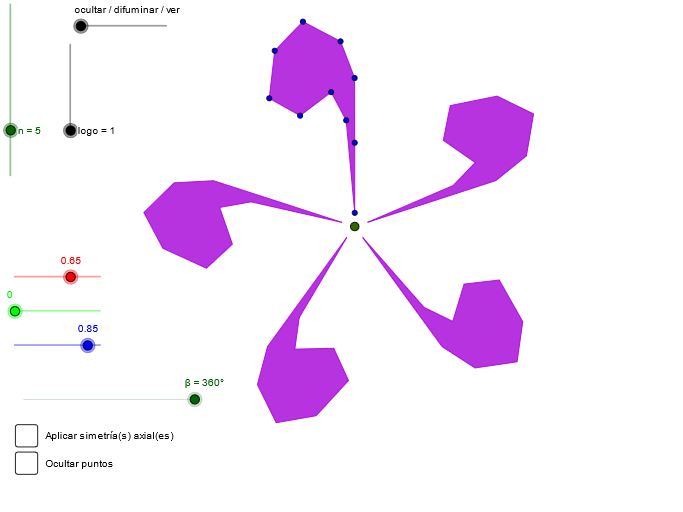
This example demonstrates the creation of a polygon with rotational symmetry using geometric transformations. Key mathematical concepts include geometric transformations, function graphing, and sequence generation. Construction involves GeoGebra commands such as Line, Polygon, Mirror, Rotate, and Sequence, with objects like A, B, a, n and lists like lista0, lista1. Suitable for middle or high school mathematics courses to learn geometric transformations and function graphing.
GeoGebra Commands & Parameters
Line(A, B) → aPolygon(P1, P2, P3, P4, P5, P6, P7, P8, P9, P10) → polígono1, c, l, d, e, f, g, h, i, j, kMirror(P5, a) → P5'Rotate(P5', 59.99999999999999°, P5) → P5''Rotate(P5, α, P5'') → P5'_1Sequence(Rotate[Element[lista0, k], β, A], k, 1, 10) → lista1Sequence(Auxiliarsimetría[Element[lista0, k], α, a], k, 1, 10) → lista7Sequence(Rotate[Element[lista7, k], β, A], k, 1, 10) → lista3Sequence(If[β ≥ (k * γ), {Polygon[Rotate[P1, (k * γ), A], Rotate[P2, (k * γ), A], Rotate[P3, (k * γ), A], Rotate[P4, (k * γ), A], Rotate[P5, (k * γ), A], Rotate[P6, (k * γ), A], Rotate[P7, (k * γ), A], Rotate[P8, (k * γ), A], Rotate[P9, (k * γ), A], Rotate[P10, (k * γ), A]]}], k, 1, n) → lista4Sequence(Rotate[a, (k * γ / 2), A], k, 1, (2 * n) - 1) → lista6Sequence(If[r ∧ β ≥ (k * γ), {Polygon[Rotate[Element[lista7, 1], (k * γ), A], Rotate[Element[lista7, 2], (k * γ), A], Rotate[Element[lista7, 3], (k * γ), A], Rotate[Element[lista7, 4], (k * γ), A], Rotate[Element[lista7, 5], (k * γ), A], Rotate[Element[lista7, 6], (k * γ), A], Rotate[Element[lista7, 7], (k * γ), A], Rotate[Element[lista7, 8], (k * γ), A], Rotate[Element[lista7, 9], (k * γ), A], Rotate[Element[lista7, 10], (k * γ), A]]}], k, 1, n - 1) → lista5Point(Ray[C, C + (1, 0)]) → D
AI Drawing Prompt Reference
Draw a polygon with rotational symmetry. First define a line as the axis of symmetry, then create a base polygon consisting of ten vertices. Apply mirror transformation to obtain a symmetrical version, then generate a series of rotated polygon copies through multiple rotation operations. These copies are arranged around a center point at regular angular intervals, forming a complete rotational symmetry pattern. The composition includes the original polygon, the mirrored polygon, and multiple polygon sequences at different rotation angles, presenting a regular rotational symmetric feature.
The prompt above was compiled from the original drawing commands and is for reference only.