
Rotational Animation of Parallelogram and Equilateral Triangles
Loading the math board and drawing, please wait…
In collections
Congruence (CO) Cluster
Congruence (Vol 2)
CCSS High School: Geometry (Congruence) Volume 2
CCSS High School: Geometry (Congruence) Volume 2
CCSS High School: Geometry (Congruence) Volume 2
Geometry (Congruence) Volume 2
CCSS High School: Geometry (Congruence) Volume 2
CCSS High School: Geometry (Congruence) Volume 2
CCSS High School: Geometry (Congruence) Volume 2
CCSS High School: Geometry (Congruence) Volume 2
CCSS High School: Geometry (Congruence) Volume 2
CCSS High School: Geometry (Congruence) Volume 2
CCSS High School: Geometry (Congruence) Volume 2
Gail LeBlancCCSS High School: Geometry (Congruence) Volume 2
CCSS High School: Geometry (Congruence) Volume 2
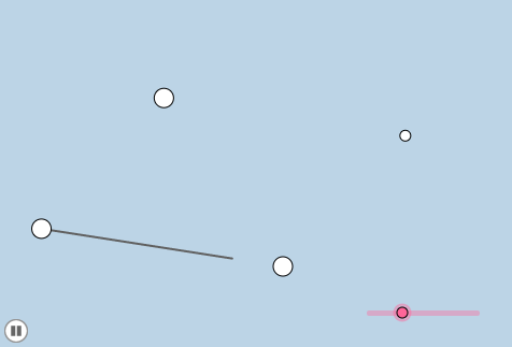
This example demonstrates a dynamic geometric animation involving a parallelogram, equilateral triangles, and a cuboid, showing transformations through rotation and vector translation. Core mathematical concepts include angles, parallelogram properties, equilateral triangles, vectors, and the connection between 2D shapes and 3D solids. Construction highlights: using GeoGebra commands such as Rotate, Angle, Ray, Line, Point, Intersect, Segment, Min, Circle, Dilate, CircleSector, Vector, Translate, and Polygon, the construction creates multiple points, segments, circles, sectors, and polygons, with a slider or animation controlling the rotation angle α to observe dynamic changes. Suitable for middle and high school geometry classes to help students understand rotation, translation, vectors, and special triangle properties, and as an example for dynamic geometry exploration.
GeoGebra Commands & Parameters
Rotate(B, a°, A) → B'Angle(B, A, B') → αRay(A, B) → fRay(A, B') → gLine(B, g) → hPoint(g) → CLine(C, f) → iIntersect(h, i) → DSegment(C, D) → jSegment(A, B) → kSegment(B, D) → lSegment(A, C) → mMin(m, k) → bCircle(C, (0.2 * b)) → dCircle(A, (0.2 * b)) → eCircle(B, (0.2 * b)) → pCircle(D, (0.2 * b)) → cIntersect(e, k, 1) → EIntersect(e, m, 1) → FIntersect(p, k, 1) → GIntersect(p, l, 1) → HIntersect(d, g, 2) → IRay(C, I) → qIntersect(c, h, 2) → JRay(D, J) → rIntersect(c, i, 2) → KRay(D, K) → sDilate(A, If[0 < o ≤ 1, 1 - o, 0], B) → A'Segment(A, A') → tRotate(E, If[1 < o ≤ 2, ((o - 1) * α), α], A) → E'CircleSector(A, E, E') → c_1Dilate(A, If[2 < o ≤ 3, 3 - o, 0], C) → A'_1Vector(A, A'_1) → uTranslate(c_1, u) → d_1Segment(A, A'_1) → f_1Dilate(C, If[3 < o ≤ 4, 4 - o, 0], D) → C'Vector(C, C') → vTranslate(d_1, v) → e_1Segment(C, C') → g_1Dilate(D, If[4 < o ≤ 5, 5 - o, 0], B) → D'Segment(D, D') → h_1Polygon(A, B, D, C) → poly1, a_1, b_1, d_2, c_2Dilate(A, If[5.5 < o ≤ 6.5, 6.5 - o, 0], C) → A'_2Vector(A, A'_2) → wTranslate(A, w) → A'_3Translate(A', w) → A''Dilate(A, If[6.5 < o ≤ 7.5, 7.5 - o, 0], B) → A'_4Vector(A, A'_4) → u_1Translate(A, u_1) → A'_5Translate(A'_1, u_1) → LIntersect(d, i) → M, NIntersect(d, g) → O, PAngle(A, C, N) → βRotate(e_1, If[5.5 < o ≤ 6.5, ((-(o - 5.5)) * π), (-π)], D) → k_1Rotate(N, If[6.5 < o ≤ 7.5, ((-(o - 6.5)) * β), (-β)], C) → N'CircleSector(C, N', N) → p_1Dilate(C, If[7.5 < o ≤ 8.5, 8.5 - o, 0], B) → C'_1Vector(C, C'_1) → v_1Translate(p_1, v_1) → q_1Rotate(q_1, If[8.5 < o ≤ 9.5, ((-(o - 8.5)) * π), (-π)], B) → r_1