
Geometric Rotation and Translation Transformation
Loading the math board and drawing, please wait…
In collections
geometriadinamica.es
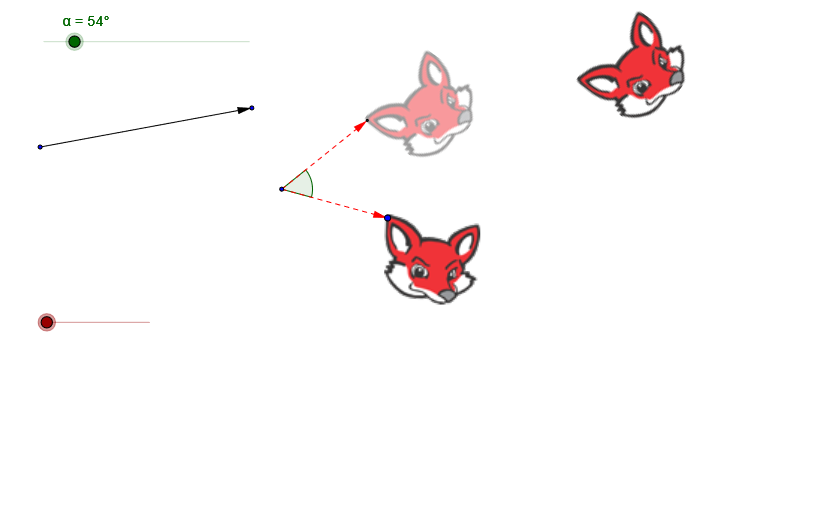
This GeoGebra example demonstrates compound geometric transformations involving rotation and translation. It shows how to construct geometric figures using the Vector command to define translation direction and distance, the Rotate command to rotate objects around specified points or angles, and the Translate command for position movement. The construction also utilizes Angle to control rotation angles, LineBisector for angle bisector construction, and Intersect to find intersection points. The example covers core concepts including rotation transformation, vector translation, and angle bisectors, making it suitable for secondary school mathematics teaching on geometric transformations, vector operations, and dynamic geometry software, helping students intuitively understand the mathematical principles of translation and rotation.
GeoGebra Commands & Parameters
Vector(A, B) → uRotate(pic1, α, A) → pic2Rotate(B, α, A) → CVector(A, C) → vAngle(B, A, C) → βVector(D, E) → wTranslate(pic2, w) → pic3Translate(C, w) → FRotate(G, α, A) → HTranslate(H, w) → ILineBisector(G, I) → aLineBisector(B, F) → bIntersect(a, b) → JAngle(B, J, F) → γRotate(pic1, (c * γ), J) → pic4
AI Drawing Prompt Reference
Draw a geometric figure with an initial shape pic1. Use vector u from point A to B to indicate the direction of translation. Rotate pic1 around point A by angle α to get pic2, and rotate point B around point A by angle α to get point C. Vector v represents the direction from A to C. Angle β is formed by points B, A, and C. Use vector w from point D to E to indicate the direction of translation, translating pic2 to pic3 and point C to F. Rotate point G around point A by angle α to get point H, then translate H to I. Construct the angle bisector a of angle G and I, and the angle bisector b of angle B and F to find their intersection point J. Angle γ is formed by points B, J, and F. Finally, rotate pic1 around point J by angle c*γ to get pic4.
The prompt above was compiled from the original drawing commands and is for reference only.