
Rotation Distributes Over Vector Addition
Loading the math board and drawing, please wait…
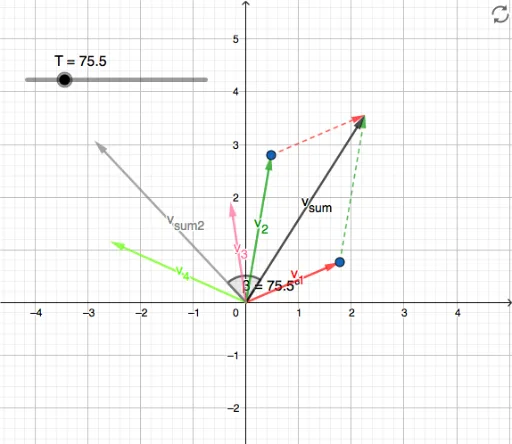
This example dynamically demonstrates the distributive property of rotation over vector addition, visually showing how the sum of vectors changes after rotation. Core math concepts include vectors, matrices, 2D transformations, rotation, and vector addition. GeoGebra commands and objects used are Vector, Angle, and objects A, v1, B, v2, u, v, vsum, T, m, C, D, v3, v4, vsum2, β. Suitable for high school mathematics and linear algebra education to understand the relationship between transformations and vectors.
GeoGebra Commands & Parameters
Vector(A) → v_{1}Vector(B) → v_{2}Vector(A, A + B) → uVector(B, B + A) → vVector(A + B) → v_{sum}Vector(C) → v_{3}Vector(D) → v_{4}Vector(C + D) → v_{sum2}Angle(v_{sum}, v_{sum2}) → β
AI Drawing Prompt Reference
Draw a 2D coordinate plane with two free points as vector origins. From the origin, draw two vectors, then construct a parallelogram using these vectors as adjacent sides, and draw the diagonal vector from the origin representing their sum. Rotate the entire configuration about the origin by an angle, obtaining the rotated vectors and their sum. Finally, mark the angle between the original sum vector and the rotated sum vector with an arc and display its measure. This illustrates that rotation distributes over vector addition.
The prompt above was compiled from the original drawing commands and is for reference only.