
Rotation Animation of an Equilateral Triangle
Loading the math board and drawing, please wait…
In collections
CCSS High School: Geometry (Congruence) Volume 2
CCSS High School: Geometry (Congruence) Volume 2
CCSS High School: Geometry (Congruence) Volume 2
CCSS High School: Geometry (Congruence) Volume 2
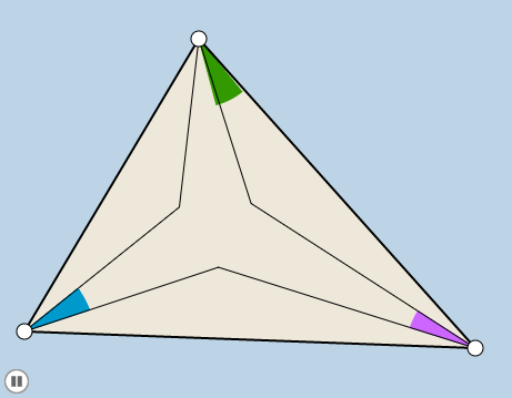
This example demonstrates the rotation of an equilateral triangle around its vertices. Key mathematical concepts include the properties of equilateral triangles, rotation transformations, and angle measurement. Using GeoGebra commands such as Rotate, Polygon, and Angle, the animation provides a visual representation of the rotation. Suitable for middle school and above students to learn geometric transformations and trigonometry.
GeoGebra Commands & Parameters
Line(A, B) → pPointIn(d) → CPolygon(A, B, C) → poly1, c, a, bAngle(poly1) → α, β, γRotate(B, α / 3, A) → B'Angle(B, A, B') → δRay(A, B') → fRotate(B', α / 3, A) → B''Angle(B', A, B'') → εRay(A, B'') → gRotate(C, β / 3, B) → C'Angle(C, B, C') → ζRay(B, C') → hRotate(C', β / 3, B) → C''Angle(C', B, C'') → ηRay(B, C'') → iRotate(A, γ / 3, C) → A'Angle(A, C, A') → θRay(C, A') → jRotate(A', γ / 3, C) → A''Angle(A', C, A'') → ιRay(C, A'') → kIntersect(f, i) → DIntersect(h, k) → EIntersect(g, j) → FSegment(D, E) → lSegment(E, F) → mSegment(F, D) → nLine(A, C) → qLine(C, B) → rMin({a, b, c}) → sSegment(A, B) → tSegment(B, C) → f_1Segment(C, A) → g_1Intersect(g, f_1) → GIntersect(f, f_1) → HIntersect(g_1, h) → IIntersect(g_1, i) → JIntersect(k, t) → KIntersect(j, t) → LCircle(A, (0.2 * s)) → c_1Circle(B, (0.2 * s)) → d_1Circle(C, (0.2 * s)) → e_1Intersect(d_1, f_1, 1) → MIntersect(d_1, h) → N,Intersect(c_1, f, 1) → OIntersect(c_1, t, 1) → PIntersect(e_1, g_1, 1) → QIntersect(e_1, j, 1) → RCircleSector(B, M, N) → h_1CircleSector(A, P, O) → k_1CircleSector(C, Q, R) → p_1Polygon(D, E, F) → poly2, f_2, d_2, e_2Dilate(A, If[0 < u ≤ 1, 1 - u, 0], D) → A'_1Dilate(B, If[0 < u ≤ 1, 1 - u, 0], E) → B'_1Dilate(C, If[0 < u ≤ 1, 1 - u, 0], F) → C'_1Segment(A, A'_1) → i_1Segment(B, B'_1) → j_1Segment(C, C'_1) → l_1Dilate(A, If[1 < u ≤ 2, 2 - u, 0], F) → A'_2Dilate(B, If[1 < u ≤ 2, 2 - u, 0], D) → B'_2Dilate(C, If[1 < u ≤ 2, 2 - u, 0], E) → C'_2Segment(A, A'_2) → m_1Segment(C, C'_2) → n_1Segment(B, B'_2) → q_1Rotate(k_1, If[2 < u ≤ 3, (((u - 2) * 2) * α / 3), (2 * α / 3)], A) → r_1Rotate(r_1, If[3.5 < u ≤ 4.5, ((-(u - 3.5)) * α / 3), ((-α)) / 3], A) → s_1Rotate(h_1, If[4.5 < u ≤ 5.5, (((u - 4.5) * 2) * β / 3), (2 * β / 3)], B) → t_1Rotate(t_1, If[6 < u ≤ 7, ((-(u - 6)) * β / 3), ((-β)) / 3], B) → c_2Rotate(p_1, If[7 < u ≤ 8, (((u - 7) * 2) * γ / 3), (2 * γ / 3)], C) → g_2Rotate(g_2, If[8.5 < u ≤ 9.5, ((-(u - 8.5)) * γ / 3), ((-γ)) / 3], C) → h_2Dilate(D, If[11 < u ≤ 12, 12 - u, 0], E) → D'Segment(D, D') → a_1Rotate(D, If[12 < u ≤ 13, ((u - 12) * π / 3), π / 3], D) → D'_1Rotate(D', If[12 < u ≤ 13, ((u - 12) * π / 3), π / 3], D) → D''Segment(D'_1, D'') → b_1Rotate(D'_1, If[13 < u ≤ 14, ((u - 13) * π / 3), π / 3], F) → SRotate(D'', If[13 < u ≤ 14, ((u - 13) * π / 3), π / 3], F) → D'''Segment(S, D''') → i_2