
Law of Sines: Intro via Areas
Loading the math board and drawing, please wait…
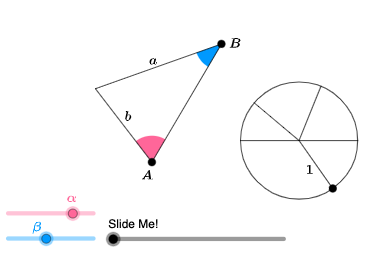
This example demonstrates the Law of Sines using the area method, involving core concepts like the Law of Sines, triangle area formulas, and the relationship between circles and angles. Construction highlights include using GeoGebra commands like Intersect, Circle, Rotate, Segment to build triangles and angles, and transformations with Dilate and Translate. Suitable for high school students learning trigonometry and geometry.
GeoGebra Commands & Parameters
Intersect(xAxis, yAxis) → ACircle(A, 1) → cRotate((1, 0), (a * π / 180), A) → BRotate(D, (a * π / 180), C) → D'Ray(C, D') → fSegment(C, D) → gRotate(C, ((-b) * π / 180), D) → C'Ray(D, C') → hIntersect(f, h) → ESegment(C, E) → iSegment(E, D) → jRotate((-1, 0), ((-b) * π / 180), A) → FSegment(A, B) → kSegment(A, F) → lMin({1, i, g, j}) → dCircle(C, (0.45 * d)) → eCircle(E, (0.45 * d)) → pCircle(D, (0.45 * d)) → qIntersect(e, g, 1) → GIntersect(e, i, 1) → HIntersect(p, j, 1) → IIntersect(p, i, 1) → JIntersect(q, g, 1) → KIntersect(q, j) → L,CircleSector(C, G, H) → rCircleSector(D, L, K) → tLine(C, xAxis) → mPoint(m) → MAngle(M, C, G) → αDilate(C, If[0 < n ≤ 1, 1 - n, 0], A) → C'_{1}Vector(C, C'_{1}) → uTranslate(r, u) → r'Rotate(r', If[0 < n ≤ 1, ((-n) * α), (-α)], C'_{1}) → r''Line(D, xAxis) → f_1Point(f_1) → NAngle(N, D, K) → βDilate(D, If[1 < n ≤ 2, 2 - n, 0], A) → D'_{1}Vector(D, D'_{1}) → vTranslate(t, v) → t'Rotate(t', If[1 < n ≤ 2, ((-β) * (n - 1)), (-β)], D'_{1}) → t''Dilate(B, If[2 < n ≤ 3, 3 - n, 0], O) → B'Dilate(F, If[2 < n ≤ 3, 3 - n, 0], P) → F'Segment(B, B') → g_1Segment(F, F') → h_1Angle(B, O, A) → γAngle(A, P, F) → δDilate(B, If[4 < n ≤ 5, 5 - n, 0], E) → B'_{1}Vector(B, B'_{1}) → u_1Translate(B, u_1) → B'_{2}Translate(B', u_1) → B''Segment(B'_{2}, B'') → i_1OrthogonalLine(E, i) → j_1Line(E, g_1) → k_1Point(j_1) → QPoint(k_1) → RAngle(Q, E, R) → εRotate(B'_{2}, If[4 < n ≤ 5, ((-(n - 4)) * ε), (-ε)], B'_{2}) → SRotate(B'', If[4 < n ≤ 5, ((-(n - 4)) * ε), (-ε)], B'_{2}) → B'''Segment(S, B''') → l_1Angle(Q, E, C) → ζDilate(E, If[5 < n ≤ 6, 6 - n, 0], B''') → E'Vector(E, E') → v_1Translate(C, v_1) → C'_{2}Translate(E, v_1) → E'_{1}Segment(C'_{2}, E'_{1}) → i'Angle(E, C, C'_{2}) → ηDilate(E, If[6 < n ≤ 7, 7 - n, 0], C) → E'_{2}Vector(E, E'_{2}) → w_1Translate(S, w_1) → S'Translate(B''', w_1) → TSegment(S', T) → m_1Dilate(P, If[8 < n ≤ 9, 9 - n, 0], D) → P'Vector(P, P') → a_1Translate(F, a_1) → F'_{1}Translate(F', a_1) → F''Segment(F'_{1}, F'') → n_1OrthogonalLine(D, j) → p_1Line(D, h_1) → q_1Point(q_1) → UPoint(p_1) → VAngle(U, D, V) → θRotate(F'_{1}, If[8 < n ≤ 9, ((n - 8) * θ), θ], F'') → WRotate(F'', If[8 < n ≤ 9, ((n - 8) * θ), θ], F'') → F'''Segment(W, F''') → r_1Angle(W, D, E) → ιDilate(D, If[9 < n ≤ 10, 10 - n, 0], E) → D'_{2}Vector(D, D'_{2}) → b_1Translate(W, b_1) → W'Translate(F''', b_1) → ZSegment(W', Z) → s_1Angle(D, E, W') → κDilate(E, If[10 < n ≤ 11, 11 - n, 0], W') → E'_{3}Vector(E, E'_{3}) → c_1Translate(E, c_1) → E'_{4}Translate(D, c_1) → D'_{3}Segment(E'_{4}, D'_{3}) → j'Polygon(D, W, W', E) → q1, d_1, w_2, w', e_1Circle(D, i) → t_1Ray(W, W') → f_2Intersect(t_1, f_2) → A_1,Dilate(W, If[13 < n ≤ 14, 14 - n, 0], A_1) → W'_{1}Vector(W, W'_{1}) → u_2Translate(W', u_2) → W''Polygon(D, W'_{1}, W'', E) → q2, d_2, w'_{1}, w'', e_2Line(A_1, D) → g_2Line(W'', E) → i_2OrthogonalLine(D, g_2) → h_2Intersect(i_2, h_2) → B_1Dilate(E, If[15 < n ≤ 16, 16 - n, 0], B_1) → E'_{5}Vector(E, E'_{5}) → v_2Translate(W'', v_2) → W'''Polygon(D, W'_{1}, W''', E'_{5}) → q3, d_3, j_2, w''', e'_{5}Dilate(W''', If[17 < n ≤ 18, 18 - n, 0], B''') → C_1Vector(W''', C_1) → a_2Translate(D, a_2) → D'_{4}Translate(W'_{1}, a_2) → D_1Translate(W''', a_2) → E_1Translate(E'_{5}, a_2) → F_1Polygon(D'_{4}, D_1, E_1, F_1) → q3', d'_{4}, k_2, l_2, m_2Line(B''', g_2) → n_2Point(n_2) → G_1Angle(C'_{2}, B''', G_1) → λRotate(D'_{4}, If[17 < n ≤ 18, ((-(n - 17)) * λ), (-λ)], E_1) → H_1Rotate(D_1, If[17 < n ≤ 18, ((-(n - 17)) * λ), (-λ)], E_1) → I_1Rotate(E_1, If[17 < n ≤ 18, ((-(n - 17)) * λ), (-λ)], E_1) → J_1Rotate(F_1, If[17 < n ≤ 18, ((-(n - 17)) * λ), (-λ)], E_1) → K_1Polygon(H_1, I_1, J_1, K_1) → q3'', p_2, q_2, r_2, s_2Line(W', W) → t_2Line(E, D) → b_2Line(W'_{1}, D) → c_2Line(W''', E) → f_3Segment((-1, 0), (1, 0)) → sPoint(c) → L_1Segment((0, 0), L_1) → g_3
AI Drawing Prompt Reference
In a coordinate plane, use the axes with the origin as reference. Draw two perpendicular axes and a circle centered at a chosen reference point with radius 1. From that center, rotate to place corresponding points on the circle and connect them to form a triangle; use rays along relevant directions to create intersection points. Using a shared scale factor based on the minimal among key segment lengths, draw three circles with equal scaled radii around three triangle vertices, then compute their intersections with the previously constructed segments/lines to obtain several additional points. Construct two circle-sector regions at the appropriate vertices using those intersection points, and add angle markings at key intersections to highlight the area-based relationship underlying the Law of Sines.
The prompt above was compiled from the original drawing commands and is for reference only.