
Rotating Cubes
Loading the math board and drawing, please wait…
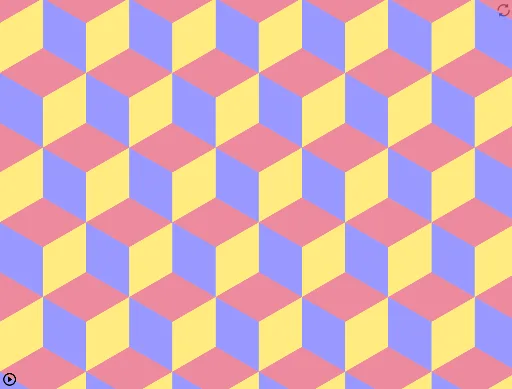
This example demonstrates rotating cubes. It involves 3D geometry transformations. Using Vector, Rotate, Sequence, Polygon, and other GeoGebra commands, dynamic rotating cubes can be constructed. Suitable for high school and above students or teachers for geometry instruction.
GeoGebra Commands & Parameters
Vector((0, 0), (3^(0.5), 3)) → vVector((0, 0), ((2 * 3^(0.5)), 0)) → uRotate(D, α, (0, 1)) → D'Rotate(C, α, (0, 1)) → C'Rotate(B, α, (0, 1)) → B'Rotate(A, α, (0, 1)) → A'Sequence(Polygon[Translate[A', Vector[(u * mmm)]], Translate[C', Vector[(u * mmm)]], Translate[B', Vector[(u * mmm)]], Translate[D', Vector[(u * mmm)]]], mmm, -4, 4, 1) → L_9Polygon(A', C', B', D') → q1, a', c', b', d'Sequence(Translate[L_9, Vector[(v * mmm)]], mmm, -5, 5, 1) → L_2Rotate(L_2, (2 * π / 3), (0, 1)) → L_3Rotate(L_2, (4 * π / 3), (0, 1)) → L_4Rotate(L_2, 0, (0, 1)) → L_5Rotate(E, α, (0, 5)) → E'Rotate(F, α, (0, 5)) → F'Rotate(G, α, (0, 5)) → G'Rotate(H, α, (0, 5)) → H'Polygon(E', F', G', H') → q2, e', f', g', h'Sequence(Polygon[Translate[E', Vector[(u * mmm)]], Translate[F', Vector[(u * mmm)]], Translate[G', Vector[(u * mmm)]], Translate[H', Vector[(u * mmm)]]], mmm, -5, 5, 1) → L_1Sequence(Translate[L_1, Vector[(v * mmm)]], mmm, -5, 5, 1) → L_6Rotate(L_6, (2 * π / 3), (3^(0.5), 2)) → L_7Rotate(L_6, (4 * π / 3), (3^(0.5), 2)) → L_8Rotate(L_6, 0, (3^(0.5), 2)) → L_{10}If(α < (2 * π / 3) ∨ α > (4 * π / 3) ∧ α < (2 * π) ∨ α > (8 * π / 3) ∧ α < (10 * π / 3), 1, 0) → aa