
Rotate Trapezoid: 3D Solid of Revolution and Integral Visualization
Loading the math board and drawing, please wait…
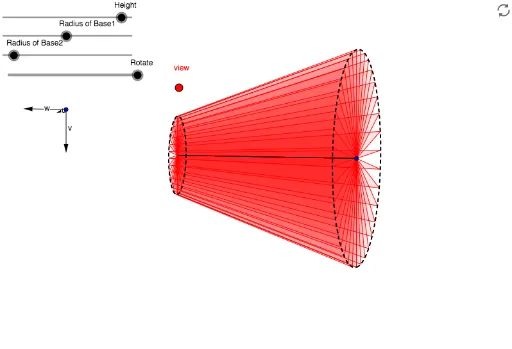
This example demonstrates the dynamic rotation of a planar trapezoid around an axis to form a three-dimensional solid of revolution, visually linking the volume of the rotated shape to integral calculus. Core mathematical concepts include solids of revolution, definite integrals, geometric mean, parametric curves, and vector transformations. Construction highlights: using GeoGebra commands such as Vector, OrthogonalLine, Sequence, Translate, CurveCartesian, Polygon, and Segment, the trapezoid's vertices, rotation axis, angle slider (speed), and rotated 3D mesh (liste3, liste7, liste8) are built. The Rotate command animates the rotation, while Zoom adjusts the view. Suitable for high school to university students studying calculus, solid geometry, or mathematical modeling, this tool helps visualize and verify the volume formula of a solid of revolution.
GeoGebra Commands & Parameters
Vector(B_1, X) → uVector(B_1, Y) → vOrthogonalLine(view, yAxis) → a_1OrthogonalLine(view, xAxis) → bVector(B_1, Z) → wSequence((x(B), y(B)) - (Radius_1 * (((sin(0°) * sin(i°)) * w) + ((cos(0°) * sin(i°)) * u) - (cos(i°) * v))), i, 0, k, n) → liste3Translate(B, Vector[(Height * w)]) → B'Sequence((x(B'), y(B')) - (Radius * (((sin(0°) * sin(i°)) * w) + ((cos(0°) * sin(i°)) * u) - (cos(i°) * v))), i, 0, k, n) → liste7Sequence(Polygon[B, Element[liste3, i], Element[liste7, i], B'], i, 0, Rotate) → liste8CurveCartesian(x(B - (Radius_1 * (((0 * sin(i)) * w) + (sin(i) * u) - (cos(i) * v)))), y(B - (Radius_1 * (((0 * sin(i)) * w) + (sin(i) * u) - (cos(i) * v)))), i, 0, 6.283185307179586) → aCurveCartesian(x(B' - (Radius * (((0 * sin(i)) * w) + (sin(i) * u) - (cos(i) * v)))), y(B' - (Radius * (((0 * sin(i)) * w) + (sin(i) * u) - (cos(i) * v)))), i, 0, 6.283185307179586) → hPolygon(B, B', Element[liste7, Rotate], Element[liste3, Rotate]) → poly3, b_1, b', c_1, d_1Segment(B', B) → h_1