
Conjecture for the Volume of a Pyramid (Copy)
Loading the math board and drawing, please wait…
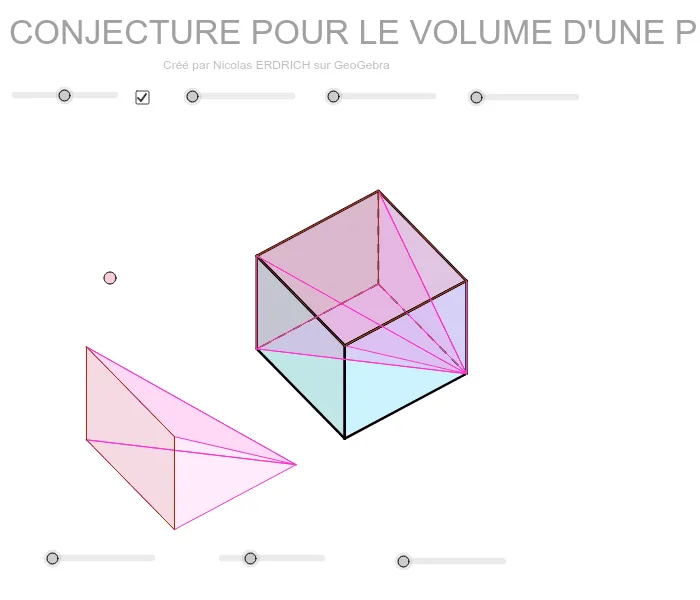
① This GeoGebra example dynamically constructs a pyramid and related geometric elements to visually demonstrate the relationship between pyramid volume, base area, and height, guiding users to conjecture the volume formula. ② Core mathematical concepts include the pyramid volume formula (V = 1/3 × base area × height), definite integrals in volume computation, arithmetic mean, and connections to triangles and spheres. ③ Construction highlights: from the summary, commands such as Sequence, Element, Point, Polygon, Segment, PointIn, and Translate are used, creating multiple points, polygons, segments, and auxiliary objects (z, w, v, a, O, P, α, β, sinα, cosα), with a slider (echelle) for scaling and translation to create a copy (cube'), plus text objects for formulas. ④ Suitable for high school or early college students in solid geometry, exploratory learning of volume formulas, and as an intuitive introduction to definite integral applications.
GeoGebra Commands & Parameters
Sequence(Mat * Element[cube, k], k, 1, 8) → cube'Element(Element[AE, 3], 1) → droiteSequence((Element[cube', k, 1, 1], Element[cube', k, 2, 1]), k, 1, 8) → listepointsPoint(listepoints) → APoint(listepoints) → EPoint(listepoints) → C_1Point(listepoints) → DPolygon(A, E, C_1, D) → poly1, a_1, b, c_1, dPoint(listepoints) → BPoint(listepoints) → FPoint(listepoints) → GPoint(listepoints) → HPolygon(B, F, G, H) → poly2, e, f, g, hPoint(listepoints) → CPolygon(F, C, A, B) → poly3, f_1, i, a_2, b_1Element(AB, 3, 1) → avantPolygon(C_1, G, H, E) → poly4, c_2, g_1, h_1, e_1Element(AC, 3, 1) → dessusPolygon(F, C, C_1, G) → poly5, f_2, c_3, c_4, g_2Polygon(A, B, H, E) → poly6, a_3, b_2, h_2, e_2Segment(E, A) → cSegment(A, C) → jSegment(A, B) → kSegment(C, C_1) → lSegment(C_1, E) → mSegment(H, E) → nSegment(A, B) → pSegment(B, H) → qSegment(H, E) → rSegment(H, G) → sSegment(B, F) → tSegment(G, C_1) → d_1Segment(F, G) → i_1Segment(F, C) → j_1PointIn(poly5) → JTranslate(J, Vector[val1 * Vector[A, B]]) → pyr1_1Translate(A, Vector[val1 * Vector[A, B]]) → pyr1_2Translate(B, Vector[val1 * Vector[A, B]]) → pyr1_3Translate(H, Vector[val1 * Vector[A, B]]) → pyr1_4Translate(E, Vector[val1 * Vector[A, B]]) → pyr1_5Polygon(pyr1_1, pyr1_2, pyr1_3) → poly11, pyr1_6, pyr1_7, pyr1_8Polygon(pyr1_1, pyr1_3, pyr1_4) → poly12, pyr1_9, pyr1_{10}, pyr1_{11}Polygon(pyr1_5, pyr1_1, pyr1_2) → poly13, pyr1_{12}, pyr1_{13}, pyr1_{14}Polygon(pyr1_5, pyr1_4, pyr1_3, pyr1_2) → poly14, pyr1_{15}, pyr1_{16}, pyr1_{17}, pyr1_{18}Translate(J, Vector[val2 * Vector[A, E]]) → pyr2_1Translate(E, Vector[val2 * Vector[A, E]]) → pyr2_2Translate(H, Vector[val2 * Vector[A, E]]) → pyr2_3Translate(C_1, Vector[val2 * Vector[A, E]]) → pyr2_4Translate(G, Vector[val2 * Vector[A, E]]) → pyr2_5Polygon(pyr2_1, pyr2_2, pyr2_3) → poly15, pyr2_6, pyr2_7, pyr2_8Polygon(pyr2_1, pyr2_4, pyr2_5) → poly16, pyr2_9, pyr2_{10}, pyr2_{11}Polygon(pyr2_1, pyr2_3, pyr2_5) → poly17, pyr2_{12}, pyr2_{13}, pyr2_{14}Polygon(pyr2_4, pyr2_2, pyr2_3, pyr2_5) → poly18, pyr2_{15}, pyr2_{16}, pyr2_{17}, pyr2_{18}Translate(J, Vector[val3 * Vector[D, A]]) → pyr3_1Translate(F, Vector[val3 * Vector[D, A]]) → pyr3_2Translate(B, Vector[val3 * Vector[D, A]]) → pyr3_3Translate(G, Vector[val3 * Vector[D, A]]) → pyr3_4Translate(H, Vector[val3 * Vector[D, A]]) → pyr3_5Polygon(pyr3_1, pyr3_3, pyr3_2) → poly19, pyr3_6, pyr3_7, pyr3_8Polygon(pyr3_2, pyr3_4, pyr3_5, pyr3_3) → poly20, pyr3_9, pyr3_{10}, pyr3_{11}, pyr3_{12}Polygon(pyr3_1, pyr3_2, pyr3_4) → poly21, pyr3_{13}, pyr3_{14}, pyr3_{15}Polygon(pyr3_1, pyr3_5, pyr3_4) → poly22, pyr3_{16}, pyr3_{17}, pyr3_{18}