
Roots of Related Cubics: α+k, β+k, γ+k
Loading the math board and drawing, please wait…
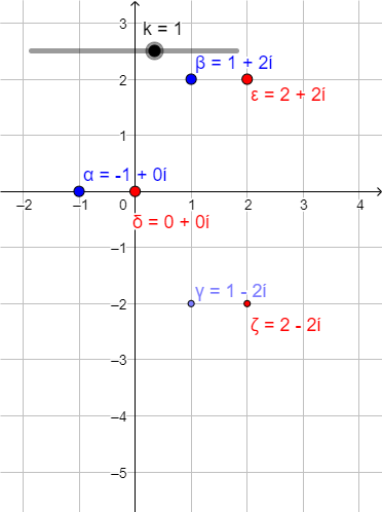
This example demonstrates how the graph and coefficients of a cubic polynomial change when its roots are each increased by a constant k. The core mathematical concept is the translation of polynomial roots: if the original cubic has roots α, β, γ, then the new cubic has roots α+k, β+k, γ+k, and its graph is shifted horizontally by k units. Construction highlights: using GeoGebra's Point tool to mark root points, the Polynomial command to define the polynomial, and LaTeX for displaying formulas; objects include k (slider), α, β, γ, d, c, b, f (polynomial), text1–text8 (labels), ε, ζ, δ, p, q, r, g, etc. The slider k dynamically adjusts the shift, allowing observation of how roots and graph move together. Suitable for high school and above, this is useful for understanding root translation, Vieta's formulas, and the connection between graph transformations and polynomial coefficients.
GeoGebra Commands & Parameters
Point(xAxis) → αPolynomial(x^(3) - (b * x^(2)) + (c * x) - d) → fLaTeX(f, true, true) → text4Polynomial(x^(3) - (p * x^(2)) + (q * x) - r) → gLaTeX(g, true, true) → text8