
Root-Mean-Squared Sinusoidal Current via Riemann Sums
Loading the math board and drawing, please wait…
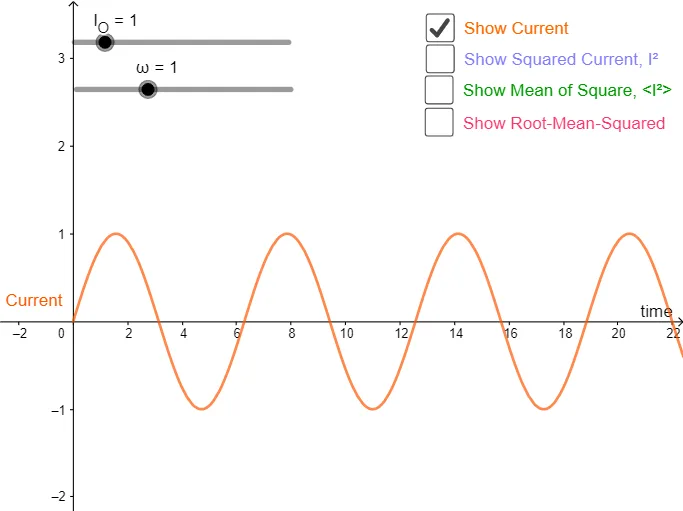
This example visualizes how to compute the root-mean-squared (RMS) current Irms for a sinusoidal current by turning the RMS definition into an area/average problem. It emphasizes the graphical decomposition of the squared sinusoidal waveform over one period and the numerical approximation of the required integral using Riemann sums (upper/lower sum intuition). Key math ideas include periodic trigonometric functions, the RMS formula expressed through an average of the square, and the use of partition width (h) and subintervals (driven by parameters like omega and T) to approximate integrals. In GeoGebra terms, the construction uses parameter objects such as omega, T, I_O, and time t to build the current function f/g, then squares and partitions the graph using objects like b, c_1, a, h, p, c, d, e, i to represent endpoints and rectangle heights for the sum approximation. Finally, it computes Irms from the accumulated approximation and displays results via text1, making it suitable for calculus/graphing lessons and early electrical engineering or physics demonstrations focused on AC quantities.
GeoGebra Commands & Parameters
Numeric omega(1)(2 * π / omega)Numeric I_O(1)f(x) = If[x ≥ 0, (I_O * sin((omega * x)))]g(x) = f(x)^(2)Boolean b(false)Numeric c_1(0)Integral[g, 0, (2 * π)] / ((2 * π))h(x) = Integral[g(x), 0, T] / Tp(x) = sqrt(h(x))0Boolean c(true)Boolean d(false)Boolean e(false)Boolean i(false)p(0)
AI Drawing Prompt Reference
Visualize the computation of the root-mean-squared current for a sinusoidal current using Riemann sums. Start by plotting a sine wave, then square it to show the graphical decomposition over one period. Use parameters for the period and current amplitude, approximate the integral using Riemann sums (upper and lower), and calculate the RMS current from the sum. Display the results, emphasizing periodic trigonometric functions, the RMS formula via averaging the square, and integral approximation with partition width and subintervals.
The prompt above was compiled from the original drawing commands and is for reference only.