
Rhombus Geometry: Angles, Slopes, and Hyperbola Exploration
Loading the math board and drawing, please wait…
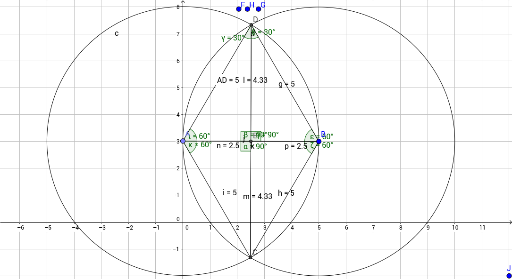
This GeoGebra example demonstrates a rhombus constructed from points, circles, and intersections, and explores its internal angles, distances, slopes, and hyperbola relationships. Core mathematical concepts include rhombus properties (equal sides, opposite angles), angle measurement, arithmetic mean, slope, and hyperbola equations. Construction highlights: using GeoGebra commands Point, Circle, Intersect, Distance, Segment, and Angle, it creates points A, B, C, D, circles c and d, segments f, g, h, i, a, j, k, and multiple angles α, β, γ, δ, ε, ζ, η, θ, along with text labels for distance AD. This resource is suitable for middle and high school geometry classes, helping students visualize the connection between rhombi and conic sections (hyperbolas), as well as how angles and slopes vary in dynamic geometry.
GeoGebra Commands & Parameters
Point(yAxis) → ACircle(A, B) → cCircle(B, A) → dIntersect(c, d, 2) → CIntersect(c, d, 1) → DDistance(A, D) → distanceADSegment(A, D) → fSegment(D, B) → gSegment(B, C) → hSegment(C, A) → iDistance(f, h) → aSegment(D, C) → jSegment(A, B) → kIntersect(j, k) → EAngle(A, E, C) → αAngle(D, E, A) → βAngle(A, D, E) → γAngle(D, (NaN, NaN), E) → δAngle(D, B, E) → εAngle(E, B, C) → ζAngle(B, E, D) → ηAngle(E, D, B) → θSegment(D, E) → lSegment(E, C) → mSegment(A, E) → nSegment(E, B) → pAngle(E, A, D) → ιAngle(C, A, E) → κ
AI Drawing Prompt Reference
Draw a rhombus formed by two intersecting circles of equal radius. Start with a point on a vertical line, use it as the center of one circle, then use a point on that circle as the center of another equal circle. The two circles intersect at two points. Connect the starting point, the two intersection points, and the other center to form a rhombus. Label all sides, diagonals, and their intersection point. Measure and display side lengths, all interior angles, and the multiple angles formed at the diagonal intersection. Show that one diagonal is perpendicular to the other, and annotate distances and angle relationships to illustrate the connection between the rhombus and a hyperbola.
The prompt above was compiled from the original drawing commands and is for reference only.