
Collecting Relationships to Set Up a Conjecture: Parallelogram and Triangle Expl
Loading the math board and drawing, please wait…
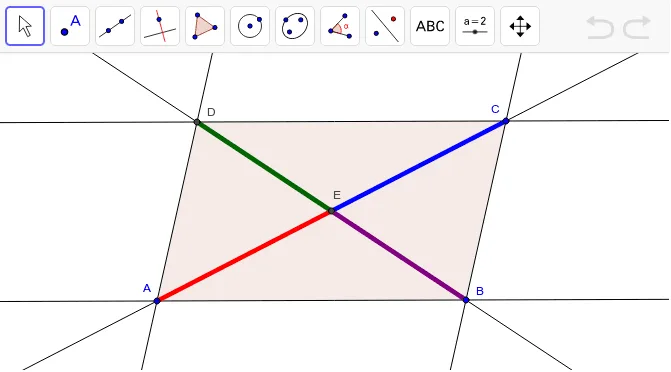
① This example demonstrates how to collect geometric relationships among parallelograms and triangles to set up a conjecture. ② Core math concepts include parallelogram properties, scalene triangle side-angle relations, intersection points, segment ratios, and inductive reasoning. ③ Construction uses GeoGebra commands Line, Intersect, Segment, and Polygon, creating objects A, B, a, C, b, c, d, D, e, f, E, g, h, poligon1, and auxiliary segments a_1, b_1, c_1, d_1, i, j; dragging vertices reveals dynamic relationships. ④ Ideal for middle/high school geometry or inquiry-based learning, fostering conjecture formulation and validation before formal proof.
GeoGebra Commands & Parameters
Line(A, B) → aLine(C, B) → bLine(C, a) → cLine(A, b) → dIntersect(c, d) → DLine(D, B) → eLine(A, C) → fIntersect(e, f) → ESegment(A, E) → gSegment(E, C) → hPolygon(A, B, C, D) → poligon1, a_1, b_1, c_1, d_1Segment(D, E) → iSegment(E, B) → j
AI Drawing Prompt Reference
Draw a parallelogram with four vertices in order. From one vertex, draw two lines through the two adjacent vertices, then draw lines parallel to these through the opposite vertex, intersecting at a point outside the parallelogram. Connect this intersection point to one vertex of the parallelogram, and also connect that vertex to a point on the opposite side, forming a diagonal. On this diagonal, mark a point such that it forms a triangle with a vertex of the parallelogram and the external intersection point. Finally, connect this point to other vertices of the parallelogram with segments to show the proportional relationships between the triangle and the parallelogram.
The prompt above was compiled from the original drawing commands and is for reference only.