
Analytical Geometry: Parallelogram Properties and Construction
Loading the math board and drawing, please wait…
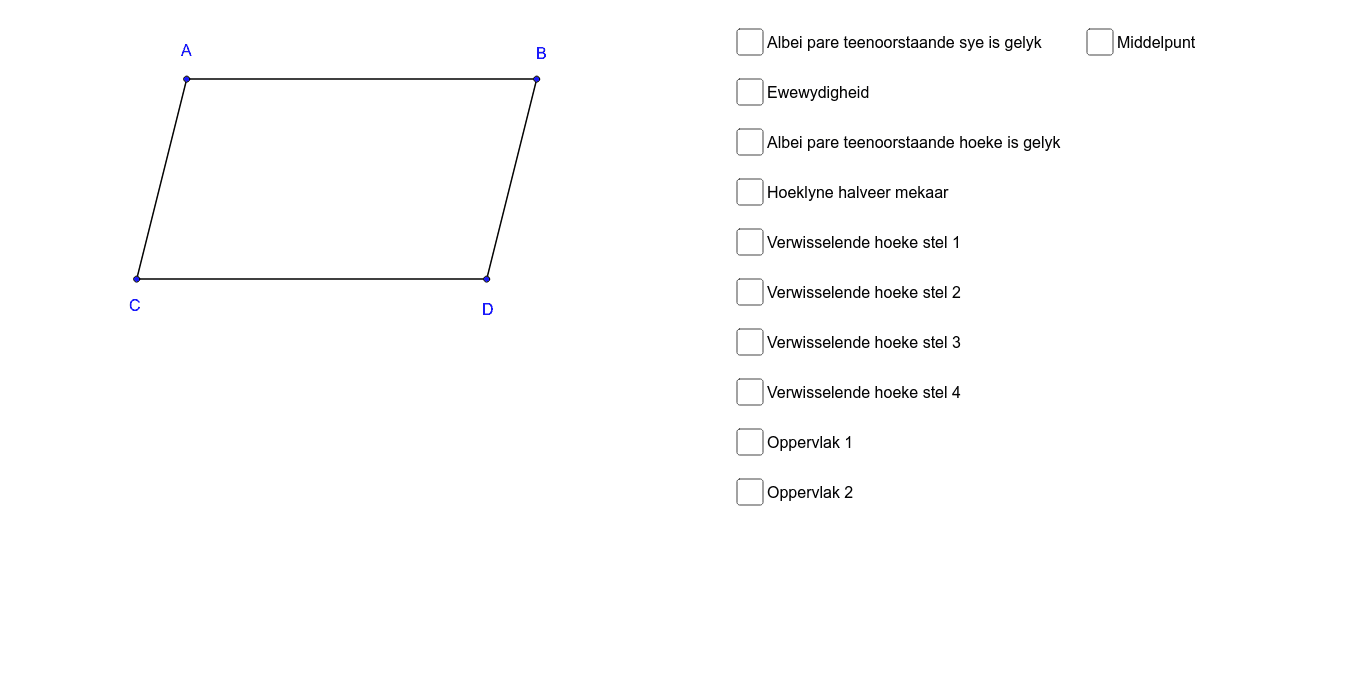
This example demonstrates the geometric properties of a parallelogram within analytical geometry. Core concepts involve vector operations, coordinate relationships, and polygon attributes. Construction utilizes GeoGebra commands such as Segment, Line, Angle, Polygon, and PointIn to define vertices and edges. It is suitable for high school geometry students or educators for interactive classroom demonstrations to visualize parallelogram theorems.
GeoGebra Commands & Parameters
Segment(A, B) → aSegment(C, D) → bSegment(A, C) → cSegment(B, D) → dSegment(E, B) → eSegment(E, D) → fSegment(E, C) → gSegment(E, A) → hLine(A, a) → iLine(D, i) → jLine(F, c) → kAngle(E, D, C) → αAngle(B, D, E) → βAngle(E, A, B) → γAngle(C, A, E) → δAngle(D, C, E) → εAngle(A, B, E) → ζAngle(E, B, D) → ηAngle(E, C, A) → θSegment(C, D) → tSegment(A, C) → a_1Segment(B, D) → b_1Segment(A, B) → c_1Angle(C, A, B) → κAngle(B, D, C) → λAngle(A, B, D) → μAngle(D, C, A) → νSegment(B, A) → d_1Segment(A, D) → e_1Segment(D, C) → f_1Segment(C, A) → h_1Segment(A, D) → i_1Segment(D, B) → j_1Segment(A, C) → l_1Segment(C, B) → m_1Segment(B, D) → n_1Segment(A, B) → p_1Segment(B, C) → q_1Segment(C, D) → r_1Segment(A, B) → a_2Segment(A, C) → b_2Segment(C, D) → c_2Segment(D, B) → d_2Polygon(A, B, D) → poly1, d_3, a_3, b_3PointIn(poly1) → Pointpoly1Polygon(A, C, D) → poly2, d_4, a_4, c_3PointIn(poly2) → Pointpoly2Polygon(A, C, B) → poly3, b_4, a_5, c_4Polygon(B, D, C) → poly4, c_5, b_5, d_5PointIn(poly3) → Pointpoly3PointIn(poly4) → Pointpoly4