
Subtended Angles
Loading the math board and drawing, please wait…
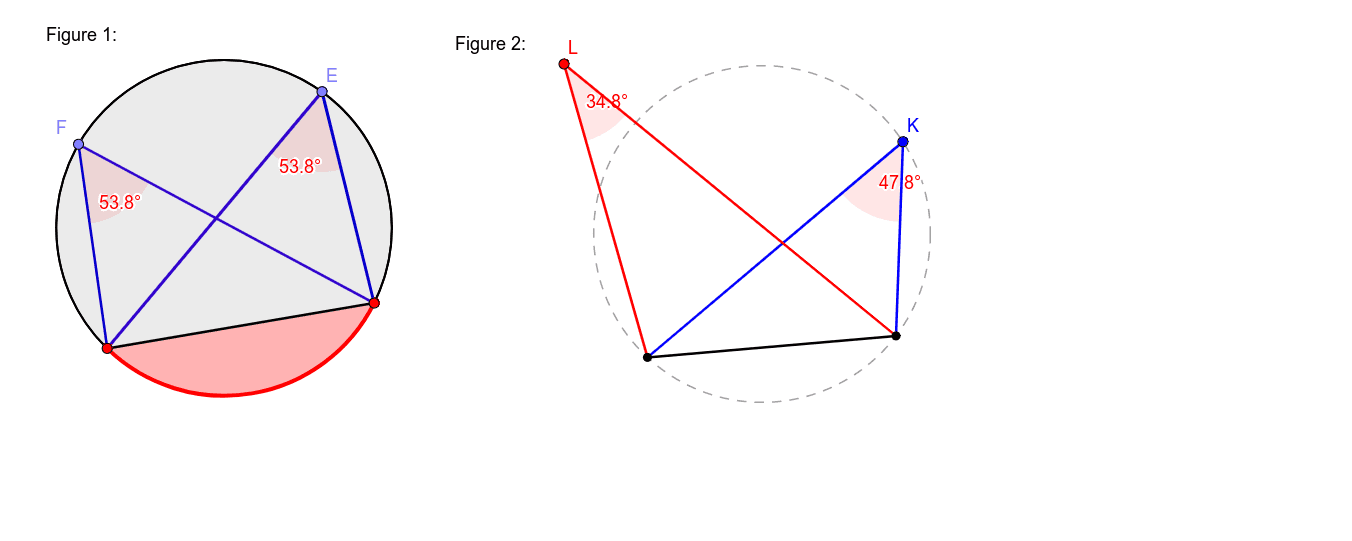
This example illustrates the concept of subtended angles. A subtended angle is formed by two chords of a circle intersecting on the circumference. Key mathematical concepts include the Inscribed Angle Theorem and the Tangent-Secant Angle Theorem. Construction highlights include the use of Circle, Point, Polygon, Angle, Segment, CircleArc, and CircumcircleArc commands. Suitable for middle school and above students studying geometry.
GeoGebra Commands & Parameters
Circle(A, B) → cPoint(c) → CPoint(c) → DPolygon(C, A, D) → poly1, d, c_1, aAngle(C, A, D) → αPoint(c) → ESegment(C, E) → bSegment(E, D) → eAngle(C, E, D) → βCircleArc(A, C, D) → fPoint(c) → FSegment(D, F) → gSegment(F, C) → hAngle(C, F, D) → δCircumcircleArc(D, E, C) → kCircle(G, H) → pPoint(p) → IPoint(p) → JSegment(I, J) → iPoint(p) → KSegment(I, K) → jSegment(K, J) → lSegment(J, L) → mSegment(L, I) → nAngle(I, L, J) → εAngle(I, K, J) → ζSegment(C, D) → q
AI Drawing Prompt Reference
Draw a circle and mark two points on its circumference. Connect these points to the center to form two chords. The intersection of these chords on the circumference creates two angles. Take another point on the circle, connect it to the intersection point and the center to form a third angle. Highlight one angle with an arc and draw the central angle corresponding to it. Finally, draw the diameter of the circle and label all angles and arcs to illustrate the relationship between inscribed angles and central angles.
The prompt above was compiled from the original drawing commands and is for reference only.