
Rhombus Folding Demonstration
Loading the math board and drawing, please wait…
In collections
Folding paper, doing geometry figures
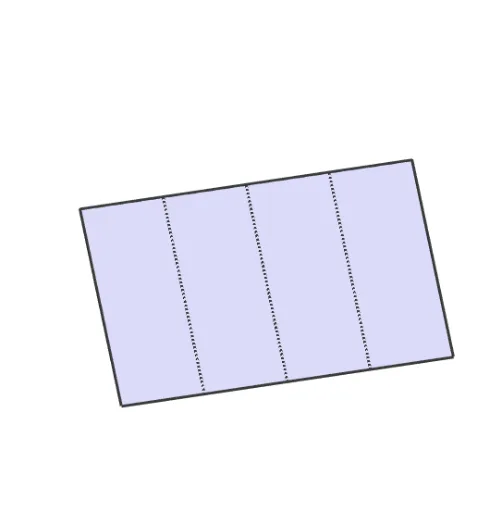
This example demonstrates the geometric transformation and symmetry of a rhombus through folding. It involves core mathematical concepts such as polygon properties, angle bisectors, symmetry axes, rotation, and reflection. The construction utilizes GeoGebra commands and objects like Polygon, Segment, Midpoint, Rotate, CircleArc, Intersect, AngularBisector, OrthogonalLine, Mirror, Circle, and Line. It is suitable for high school geometry teaching to understand rhombus symmetry and transformation geometry.
GeoGebra Commands & Parameters
Polygon(A, C, D, B) → vierhoek1, a, c, d, bSegment((sqrt(2) / 4, 0), (sqrt(2) / 4, 1)) → fSegment((sqrt(2) / 2, 0), (sqrt(2) / 2, 1)) → gSegment(((3 * sqrt(2) / 4), 0), ((3 * sqrt(2) / 4), 1)) → hMidpoint(B, D) → ERotate(D, -90°, E) → DDCircleArc(E, DD, D) → eIntersect(e, h, 1) → FCircleArc(E, F, D) → kAngularBisector(F, E, D) → iIntersect(i, c) → GSegment(E, G) → jPolygon(A, C, G, E, B) → veelhoek1, a_1, c_1, g_1, e_1, b_1Polygon(E, D, G) → driehoek1, g_2, e_2, d_1Rotate(E, (((-(s - 1)) * 180))°, g_1) → E'Rotate(D, (((-(s - 1)) * 180))°, g_1) → D'Rotate(G, (((-(s - 1)) * 180))°, g_1) → G'Polygon(E', D', G') → driehoek1', g', e', d'Polygon(E, F, G) → driehoek2, g_3, e_3, f_1Segment(E, D) → lSegment(D, G) → mOrthogonalLine(F, a_1) → nIntersect(j, d') → HHIntersect(j, d') → IIIntersect(n, j) → RIntersect(n, a_1) → SSegment(R, S) → pSegment(F, S) → qMirror(F, g) → HMirror(G, g) → ISegment(I, E) → rCircleArc(E, B, H) → tPolygon(I, E, B) → driehoek3, b_2, i_1, e_4Rotate(I, (((s - 3) * 180))°, r) → I'Rotate(E, (((s - 3) * 180))°, r) → E'_1Rotate(B, (((s - 3) * 180))°, r) → B'Polygon(I', E'_1, B') → driehoek3', b', i', e'_1Polygon(E, I, A, C, G) → veelhoek2, e_5, i_2, a_2, c_2, g_4Segment(B, E) → h_1Segment(B, I) → j_1Mirror(R, g) → TTMirror(S, g) → SSSegment(SS, TT) → k_1Segment(SS, H) → l_1Polygon(I, H, E) → driehoek4, e_6, i_3, h_2Circle(G, C) → p_1Intersect(d', f_1) → JIntersect(d', f_1) → KIntersect(d', f_1) → LIntersect(d', f_1) → MIntersect(p_1, f_1) → N,CircleArc(G, N, C) → q_1Line(G, F) → m_1Intersect(m_1, a_2) → OSegment(O, F) → n_1Polygon(O, C, G) → driehoek5, g_5, o, c_3Rotate(O, (((s - 5) * 180))°, c_3) → O'Rotate(C, (((s - 5) * 180))°, c_3) → C'Rotate(G, (((s - 5) * 180))°, c_3) → G'_1Polygon(O', C', G'_1) → driehoek5', g'_1, o', c'Polygon(I, A, O, G, E) → veelhoek3, i_4, a_3, o_1, g_6, e_7Mirror(O, n_1) → O'_1Mirror(C, n_1) → C'_1Mirror(G, n_1) → G'_2Polygon(O'_1, C'_1, G'_2) → driehoek5'_1, g'_2, o'_1, c'_1Mirror(O, g) → O'_2Mirror(C, g) → C'_2Mirror(G, g) → G'_3Polygon(O'_2, C'_2, G'_3) → driehoek5'_2, g'_3, o'_2, c'_2Rotate(O, (((s - 5) * 180))°, c_3) → O'_3Rotate(G, (((s - 5) * 180))°, c_3) → G'_4Rotate(O'_2, (((-(s - 6)) * 180))°, c'_2) → QRotate(G'_3, (((-(s - 6)) * 180))°, c'_2) → UIntersect(c', o_1) → VIntersect(c', o_1) → WIntersect(c', o_1) → ZLine(I, H) → r_1Intersect(o_1, r_1) → TSegment(O, C) → s_1Segment(C, G) → t_1Polygon(I, A, O, T) → vierhoek2, i_5, a_4, o_2, t_2Rotate(I, (((-(s - 7)) * 180))°, t_2) → I'_1Rotate(A, (((-(s - 7)) * 180))°, t_2) → A'Rotate(O, (((-(s - 7)) * 180))°, t_2) → O'_4Rotate(T, (((-(s - 7)) * 180))°, t_2) → T'Polygon(I, T, G, E) → vierhoek3, i_6, t_3, g_7, e_8Segment(E, T) → f_2Segment(T, E) → j_2Intersect(Segment[O, N], j_2) → A_1Segment(A_1, E) → k_2Rotate(I, (((-(s - 7)) * 180))°, i_6) → I'_2Rotate(A, (((-(s - 7)) * 180))°, i_6) → A'_1Rotate(O, (((-(s - 7)) * 180))°, i_6) → O'_5Rotate(T, (((-(s - 7)) * 180))°, i_6) → T'_1Polygon(I'_2, A'_1, O'_5, T'_1) → vierhoek2', i'_2, a'_1, o'_5, t'_1Mirror(N, g) → NNCircleArc(I, A, NN) → d_2Segment(I, T) → l_2Intersect(g'_2, l_2) → B_1Polygon(N, B_1, T, G) → vierhoek4, n_2, b_3, t_4, g_8Segment(I, A) → m_2Segment(A, O) → p_2