
Rhombus Diagonals Perpendicular Theorem Demo
Loading the math board and drawing, please wait…
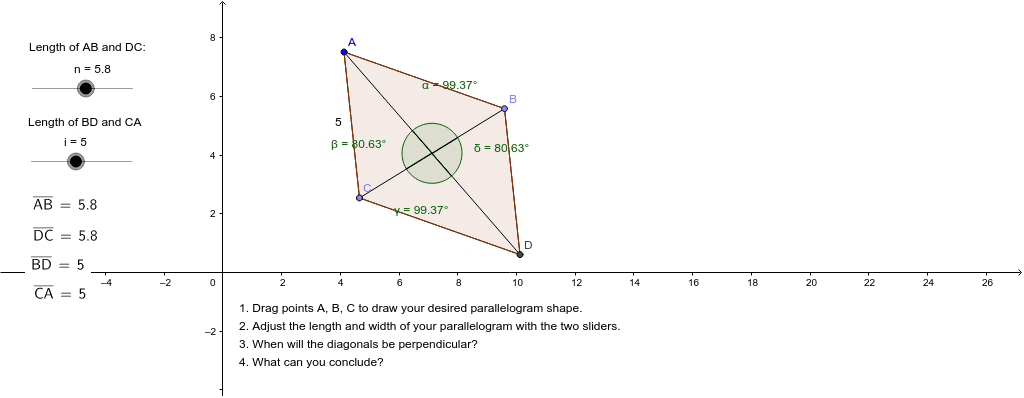
This example demonstrates the geometric property that the diagonals of a rhombus are perpendicular to each other. It involves core math concepts like rhombus, parallelogram, diagonals, and perpendicularity. Construction highlights include using GeoGebra commands/objects such as Point, Segment, Line, Intersect, Polygon, Angle, and Distance. Suitable for middle school students and geometry education.
GeoGebra Commands & Parameters
Point(Circle[A, n]) → BSegment(A, B) → aPoint(Circle[A, i]) → CSegment(A, C) → bLine(C, a) → cLine(B, b) → dIntersect(d, c) → DSegment(B, D) → eSegment(C, D) → fPolygon(A, B, D, C) → poly1, a_1, b_1, d_1, c_1Segment(A, D) → gSegment(B, C) → hIntersect(g, poly1) → E, FIntersect(h, g) → GSegment(A, G) → jSegment(B, G) → kSegment(G, C) → lSegment(G, D) → mAngle(B, G, A) → αAngle(A, G, C) → βAngle(C, G, D) → γAngle(D, G, B) → δAngle(A, G, B) → α_1Angle(C, G, A) → β_1Angle(D, G, C) → γ_1Angle(B, G, D) → δ_1Distance(A, B) → distanceABDistance(B, D) → distanceBDDistance(D, C) → distanceDCDistance(C, A) → distanceCA
AI Drawing Prompt Reference
Draw a rhombus and demonstrate that its diagonals are perpendicular. Start by creating one side of the rhombus, then use the first vertex as a center to draw a circle that intersects the opposite side to find the second vertex, completing the rhombus. Next, draw the diagonals and mark their intersection point. Finally, measure and display the angles formed by the diagonals, showing they are all right angles.
The prompt above was compiled from the original drawing commands and is for reference only.