
Rhombicosidodecahedron from Biscribed Pentakis Dodecahedron via Trisection of 1s
Loading the math board and drawing, please wait…
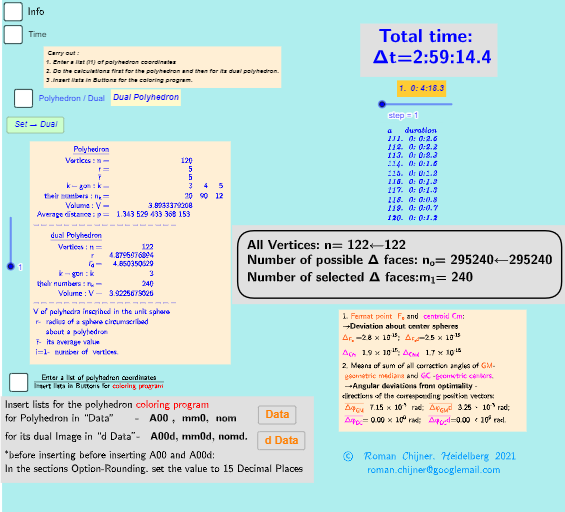
This example demonstrates how, under the condition of trisection of its 1st-order segments, one can construct a Rhombicosidodecahedron starting from a biscribed Pentakis Dodecahedron. The construction makes the geometric relationship between the two solids explicit and supports computing and comparing relevant metric quantities (e.g., volume-related measures). Key mathematics includes 3D solid geometry of related polyhedra, point/segment trisection as a geometric construction, vector-distance style measures (via Length), and parameter-driven evaluation using conditional logic and aggregation. From the GeoGebra construction summary, it uses commands such as Text (labeling results), Sum (aggregation), If (case selection), Length (distance/edge-related measures), Sequence (generating structured points/values), Div + Element/IndexOf/First (indexing and extracting items), Max (selecting extremal values), and TableText (tabular output). It also relies on objects like r, r_d, Volsphere, Volsphere_d, along with intermediate constructed entities (mm* series and A00/A00d) to drive the computed outputs. Suitable for high school advanced solid geometry through early university geometry modeling, especially for learners studying polyhedral constructions and parameterized geometric computations.
GeoGebra Commands & Parameters
Text("" + p) → txt_pSum(Flatten[Sequence[Append[Sequence[Element[txt_p, i], i, m01(k), m02(k)], " "], k, 1, 5]]) → txtUm1If(bu0, A00, A00d) → A00_0Length(A00_0) → nLength(l2) → läl2Sequence(sgn(Determinant[{Element[A00_0, i1] - Element[A00_0, j], Element[A00_0, i2] - Element[A00_0, j], Element[A00_0, i3] - Element[A00_0, j]}]), j, 1, n) → l01Length(A00d) → zzzSum(Zip[(T * F), T, SysTimeAkt1, F, {1, 1000, 60000, 3600000, 86400000}]) → TimeAbs1Sum(Zip[(T * F), T, SysTimeAkt2, F, {1, 1000, 60000, 3600000, 86400000}]) → TimeAbs2Div(TimeRelab, 3600) → HDiv(TimeRelab - (H * 3600), 60) → MElement(ZwZeit, step) → text10TableText({Append["a duration", Last[ZwZeit, Min[10, Length[ZwZeit]]]]}, "v") → text2cLength(A00) → lm1If(Length[Unique[l01 \ {0}]] ≟ 1, 7, -7) → a7Sum(Zip[(T * F), T, SysTimeAkt0, F, {1, 1000, 60000, 3600000, 86400000}]) → TimeAbs0Div(TimeRelab0, 3600) → H0Div(TimeRelab0 - (H0 * 3600), 60) → M0Text("" + (TimeRelab0 - (H0 * 3600) - (M0 * 60))) → S0aText("" + (TimeRelab - (H * 3600) - (M * 60))) → SIndexOf(".", S) → indexIndexOf(".", S0a) → indexaFirst(S, index + 1) → txtSFirst(S0a, indexa + 1) → txtS0aIf(bu0, " ", "d") → txtbuoMax(Length[A00], Length[A00d]) → maxläElement(A00, 24) → m11TableText({{"\underline{Polyhedron}"}, Append["Vertices: n=", {Length[A00]}], Append["r=", {r}], Append["\bar{r}=", {r_m}], Append["k-gon : k=", mm5a], Append["their\; numbers: n_k=", mm7a], Append["Volume: V=", {Vol_r}], Append["Average\; distance: p=", {txtUm1}]}, "hr ") → text7TableText({{"\underline{dual\;Polyhedron}"}, Append["Vertices: n=", {Length[A00d]}], Append["r=", {r_d}], Append[" \bar{r_d}= ", {r_md}], Append["k-gon : k=", mm5ad], Append["their\; numbers: n_k=", mm7ad], Append["Volume: V=", {Vold_r}]}, "hr ") → text20
AI Drawing Prompt Reference
Draw a rhombicosidodecahedron constructed from a biscribed pentakis dodecahedron by trisecting its first-order segments. Show the geometric relationship between the two solids, labeling key metrics: vertex count, circumradius, average distance, and volume. Include the trisection construction and display tables for both the original and dual polyhedra, listing face types and counts. Allow parameter toggling to compare volume and distance measures under different conditions.
The prompt above was compiled from the original drawing commands and is for reference only.