
Relationship in a Triangle with Angle Bisector and Special Segments
Loading the math board and drawing, please wait…
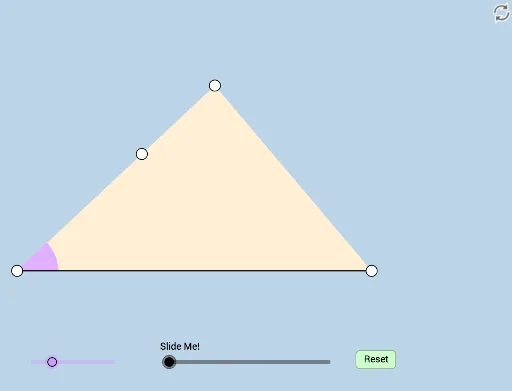
This example illustrates the relationship between the angle bisector and three special segments within a triangle. Key mathematical concepts include triangles, angle bisectors, segments, and rotation. Constructed using GeoGebra commands such as Rotate, Ray, Point, etc. Suitable for middle school and above students to learn geometric construction and transformations.
GeoGebra Commands & Parameters
Rotate(A, (a * π / 180), B) → A'Ray(B, A') → gPoint(g) → CRay(B, C) → m_1Point(m_1) → SMidpoint(A, S) → VDilate(B, If[7 < o ≤ 8, 8 - o, 0], A) → B'_1Vector(B, B'_1) → vDilate(B, If[5 < o ≤ 6, 6 - o, 0], S) → B'Translate(B', v) → B''Segment(B, B') → h_2Line(A, h_2) → k_2Point(k_2) → TAngle(T, A, C) → ζLine(C, B) → m_2Angle(A, B, A') → αSegment(B, A) → fSegment(B, C) → hCircle(B, b) → cIntersect(c, f, 1) → DIntersect(c, h, 1) → ECircleSector(B, D, E) → dSegment(C, A) → iLine(C, A) → jLine(A, B) → kOrthogonalLine(C, k) → mIntersect(m, k) → HCircle(C, 2) → eCircle(H, 2) → pIntersect(e, j, 1) → JRay(C, J) → nLine(C, H) → rPolygon(B, A, C) → poly1, c_1, b_1, a_1Angle(C, A, B) → βLine(C, B) → lOrthogonalLine(A, l) → qSegment(C, H) → sLine(C, H) → tCircle(C, 2) → d_1Circle(H, 2) → e_1Intersect(d_1, t, 1) → LIntersect(e_1, t) → M, NSegment(C, H) → h_1Circle(B, 1) → k_1Circle(A, 1) → p_1Intersect(k_1, k, 2) → PIntersect(p_1, k, 1) → QRay(B, P) → i_1Ray(A, Q) → j_1Intersect(k_1, l, 2) → KCircle(C, 2) → q_1Intersect(q_1, l, 1) → RSegment(B, C) → n_1Ray(C, R) → r_1Ray(B, K) → s_1Dilate(A, If[2 < o ≤ 3, 3 - o, 0], S) → A'_1Line(C, A) → n_2Angle(A, C, B) → γRotate(A, (-(γ / 2)), C) → A'_2Angle(A'_2, C, A) → εRay(C, A'_2) → l_1Segment(B, A) → j_2Intersect(l_1, j_2) → FSegment(C, B) → t_1Segment(C, A) → f_2Min(t_1, f_2) → uCircle(C, (0.2 * u)) → c_2Intersect(c_2, t_1, 1) → GIntersect(c_2, l_1, 1) → IDilate(C, If[0 < o ≤ 1, 1 - o, 0], F) → C'Segment(C, C') → g_2Rotate(G, If[1 < o ≤ 2, ((o - 1) * ε), ε], C) → G'CircleSector(C, G, G') → d_2Rotate(d_2, If[3 < o ≤ 4, ((o - 3) * ε), ε], C) → e_2Dilate(A, If[4 < o ≤ 5, 5 - o, 0], V) → A'_3Segment(A, A'_3) → f_1Translate(B, v) → B'_2Segment(B'_2, B'') → g_1Angle(A, B, C) → δRotate(B'_2, If[7 < o ≤ 8, ((o - 7) * δ), δ], A) → ORotate(B'', If[8 < o ≤ 9, ((o - 8) * ζ), ζ], A) → B'''Segment(O, B''') → i_2Midpoint(B, B''') → UDilate(V, If[5 < o ≤ 6, 6 - o, 0], S) → V'Segment(V, V') → l_2Rotate(A, If[6 < o ≤ 7, ((o - 6) * π), π], V) → A'_4Rotate(A'_3, If[6 < o ≤ 7, ((o - 6) * π), π], V) → WSegment(A'_4, W) → p_2Dilate(B, If[9 < o ≤ 10, 10 - o, 0], U) → B'_3Segment(B, B'_3) → q_2Dilate(U, If[10 < o ≤ 11, 11 - o, 0], B''') → U'Segment(U, U') → r_2Rotate(B, If[11 < o ≤ 12, ((-(o - 11)) * π), (-π)], U) → B'_4Rotate(B'_3, If[11 < o ≤ 12, ((-(o - 11)) * π), (-π)], U) → ZRotate(B, If[11 < o ≤ 12, ((-(o - 11)) * π), (-π)], U) → B'_5Rotate(B'_3, If[11 < o ≤ 12, ((-(o - 11)) * π), (-π)], U) → A_1Segment(B'_5, A_1) → s_2Dilate(U, If[12 < o ≤ 13, 13 - o, 0], V) → U'_1Segment(U, U'_1) → t_2Line(U, V) → a_2Intersect(g_2, a_2) → B_1Segment(U, B_1) → b_2Segment(B_1, F) → f_3Segment(B_1, V) → g_3Min({b_2, f_3, g_3}) → wCircle(B_1, (0.5 * w)) → c_3Intersect(c_3, a_2) → C_1, D_1Intersect(g_2, f_3) → E_1Intersect(g_2, f_3) → F_1Intersect(c_3, g_2) → G_1, H_1Rotate(C_1, If[14 < o ≤ 15, ((o - 14) * π / 2), π / 2], B_1) → I_1CircleSector(B_1, C_1, I_1) → d_3Rotate(d_3, If[16 < o ≤ 17, ((o - 16) * π / 2), π / 2], B_1) → e_3
AI Drawing Prompt Reference
In a triangle, illustrate the relationship between the angle bisector and three special segments. Rotate vertex A around B to get A', then draw ray g through A'. Locate point C on g and draw ray m_1 from B to C, determining point S. Find the midpoint V of BS, scale to get B'_1, and draw vector v. Translate B' by v to get B'', then draw segment h_2 and line k_2. Locate point T on k_2 and measure angle ζ. Draw line m_2 and angle α. With B as center, draw a circle intersecting f and h at D and E, then draw sector d. Draw segment i and line j, and line k from AB. Draw a perpendicular line m to k, intersecting k at H. With C and H as centers, draw circles intersecting j at J, then draw ray n and line r from CH. Finally, draw triangle BAC and measure angle β.
The prompt above was compiled from the original drawing commands and is for reference only.