
Regular Pyramid: Dynamic 3D Construction of Faces and Edges
Loading the math board and drawing, please wait…
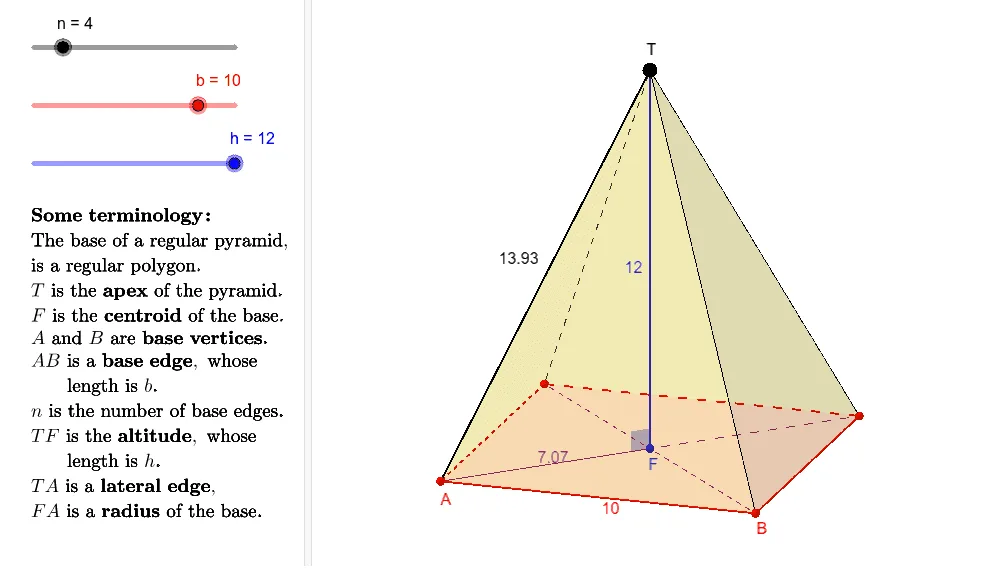
This GeoGebra example demonstrates a regular pyramid as a dynamic three-dimensional geometry model, visualizing the spatial relationships among the base polygon, apex, lateral faces, and edges. Core mathematical concepts include regular polygons, pyramids, faces and edges, points-lines-planes in solid geometry, and parametric control via variables n (number of sides), r (base radius), and h (height). Construction highlights: Polygon creates the base regular polygon, Pyramid generates the solid, and Point, Segment, Ray, and Angle label vertices, edges, and angles. Sequence commands combined with list1 and list2 batch-generate faces (face1…face10) and edges (edge1…edge10); supporting objects include b, n, r, h, F, B₁, g, poly1, T, a, C, A, B, AB, FA, α, and TA. Suitable for high school solid geometry instruction and university analytic geometry demonstrations, ideal for teaching pyramid structure or independent student exploration of regular pyramid properties.
GeoGebra Commands & Parameters
Ray(F, B_1) → gSequence(((r * cos(((2 * π) * k / n))), (r * sin(((2 * π) * k / n)))), k, 0, n - 1) → list1Polygon(list1) → poly1Pyramid(poly1, T) → a, face1, face10, edge1, edge2, edge3, edge4, edge5, edge6, edge7, edge8, edge9, face3_1, edge10, face2, face4, face5, face6, face7, face8, face9Segment(F, T) → FTPoint(list1) → CPoint(list1) → APoint(list1) → BSegment(B, A) → ABSequence(Segment[F, list1(k)], k, 1, n) → list2Segment(F, A) → FAAngle(A, F, T) → αSegment(T, A) → TA
AI Drawing Prompt Reference
Construct a regular pyramid in 3D with a regular polygonal base whose number of sides, base radius, and height are adjustable. Start by drawing the base polygon, then place an apex directly above its center. Connect the apex to each base vertex to form lateral edges and triangular faces. Label several base vertices, the segment from apex to base center, a lateral edge from apex to a base vertex, and an edge between two adjacent base vertices. Mark the angle at the apex between two lateral edges. Show all faces, edges, vertices, and the angle clearly for solid geometry study.
The prompt above was compiled from the original drawing commands and is for reference only.