
Regular Octagon Problem Dynamic Demo
Loading the math board and drawing, please wait…
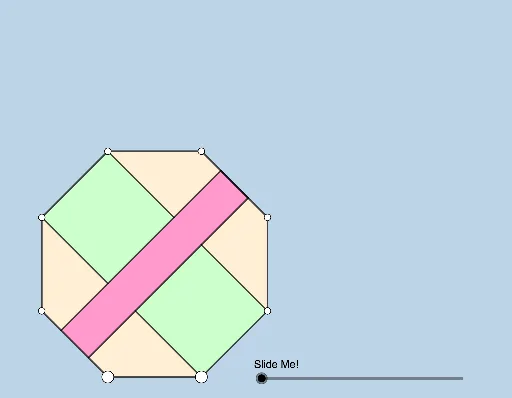
This example dynamically demonstrates a geometric problem posed by Catriona Shearer, showcasing interactive illustrations of polygonal relationships. Key math concepts include coordinate geometry, geometric transformations, limits, and curve sketching. Construction highlights GeoGebra commands like Polygon, Line, Intersect, Segment, Rotate, Circle, Dilate, Vector, Translate, OrthogonalLine, Point, and Angle. Suitable for high school and above, aiding in understanding complex geometric solutions and dynamic changes.
GeoGebra Commands & Parameters
Polygon(A, B, 8) → poly1, f, D, E, F, G, H, g, h, i, j, k, l, m, CPolygon(F, G, 4) → poly2, n, p, q, r, I, JPolygon(B, C, 4) → poly3, s, t, a, b, K, LLine(L, K) → cLine(J, I) → dIntersect(d, i) → MIntersect(c, i) → NIntersect(c, m) → OIntersect(d, m) → PPolygon(O, N, M, P) → q1, o, n_1, m_1, p_1Polygon(G, I, P, H) → q2, g_1, i_1, p_2, h_1Polygon(O, A, B, L) → q3, o_1, a_1, b_1, l_1Polygon(K, N, D, C) → q4, k_1, n_2, d_1, c_1Polygon(M, E, F, J) → q5, m_2, e, f_1, j_1Segment(G, H) → q_1Segment(H, A) → r_1Segment(A, B) → s_1Segment(B, C) → t_1Segment(C, D) → e_1Segment(D, E) → f_2Segment(E, F) → g_2Segment(F, G) → h_2Segment(O, N) → i_2Segment(M, P) → j_2Segment(C, K) → k_2Segment(L, B) → l_2Segment(J, F) → q_2Segment(I, G) → r_2Rotate(poly2, If[0 < u ≤ 1, ((u * 3) * π / 4), (3 * π / 4)], F) → poly2'Rotate(J, If[0 < u ≤ 1, ((u * 3) * π / 4), (3 * π / 4)], F) → J'Rotate(I, If[0 < u ≤ 1, ((u * 3) * π / 4), (3 * π / 4)], F) → I'Line(J', g_2) → s_2Segment(M, N) → t_2Line(D, E) → a_2Circle(F, j_2) → c_2Intersect(c_2, s_2, 1) → RDilate(J', If[2 < u ≤ 3, 3 - u, 0], R) → J''Vector(J', J'') → vTranslate(I', v) → I''Translate(F, v) → F'Polygon(F, E, I'', J'') → q6, f_3, e_2, i'', j''Segment(J'', F) → b_2Segment(E, I'') → d_2Segment(I'', J'') → g_3Rotate(G, If[0 < u ≤ 1, ((u * 3) * π / 4), (3 * π / 4)], F) → G'Segment(G', I') → h_3Segment(I', J') → i_3Segment(J', F) → j_3Segment(F, G') → k_3OrthogonalLine(E, d_2) → l_3Intersect(l_3, b_2) → SDilate(F, If[4 < u ≤ 5, 5 - u, 0], S) → F'_1Vector(F, F'_1) → wTranslate(J'', w) → J'''Polygon(F'_1, E, I'', J''') → q7, f'_1, e_3, i''_1, j'''Segment(E, F'_1) → m_3Segment(F'_1, J''') → n_3Segment(J''', I'') → p_3Dilate(E, If[6 < u ≤ 7, 7 - u, 0], O) → E'Vector(E, E') → u_1Translate(F'_1, u_1) → QTranslate(E, u_1) → E'_1Translate(I'', u_1) → I'''Translate(J''', u_1) → TPolygon(Q, E'_1, I''', T) → q7', q_3, e'_1, i''', t_3Line(O, m_3) → r_3Point(r_3) → UAngle(U, O, H) → αRotate(Q, If[6 < u ≤ 7, ((u - 6) * α), α], E'_1) → Q'Rotate(E'_1, If[6 < u ≤ 7, ((u - 6) * α), α], E'_1) → VRotate(I''', If[6 < u ≤ 7, ((u - 6) * α), α], E'_1) → WRotate(T, If[6 < u ≤ 7, ((u - 6) * α), α], E'_1) → T'Polygon(Q', V, W, T') → q7'', q', v_1, w_1, t'Line(J', g_2) → s_3Line(F, J'') → a_3
AI Drawing Prompt Reference
Draw a regular octagon and dynamically demonstrate its internal geometric relationships. First, construct the octagon, then create several quadrilaterals and triangles inside it, connecting with intersection points and line segments. Next, perform rotations and dilations on some parts to show dynamic transformations. Finally, add some auxiliary line segments and circles to enrich the figure.
The prompt above was compiled from the original drawing commands and is for reference only.