
Regression Analysis Equation Relationship Demo
Loading the math board and drawing, please wait…
In collections
Complex Math
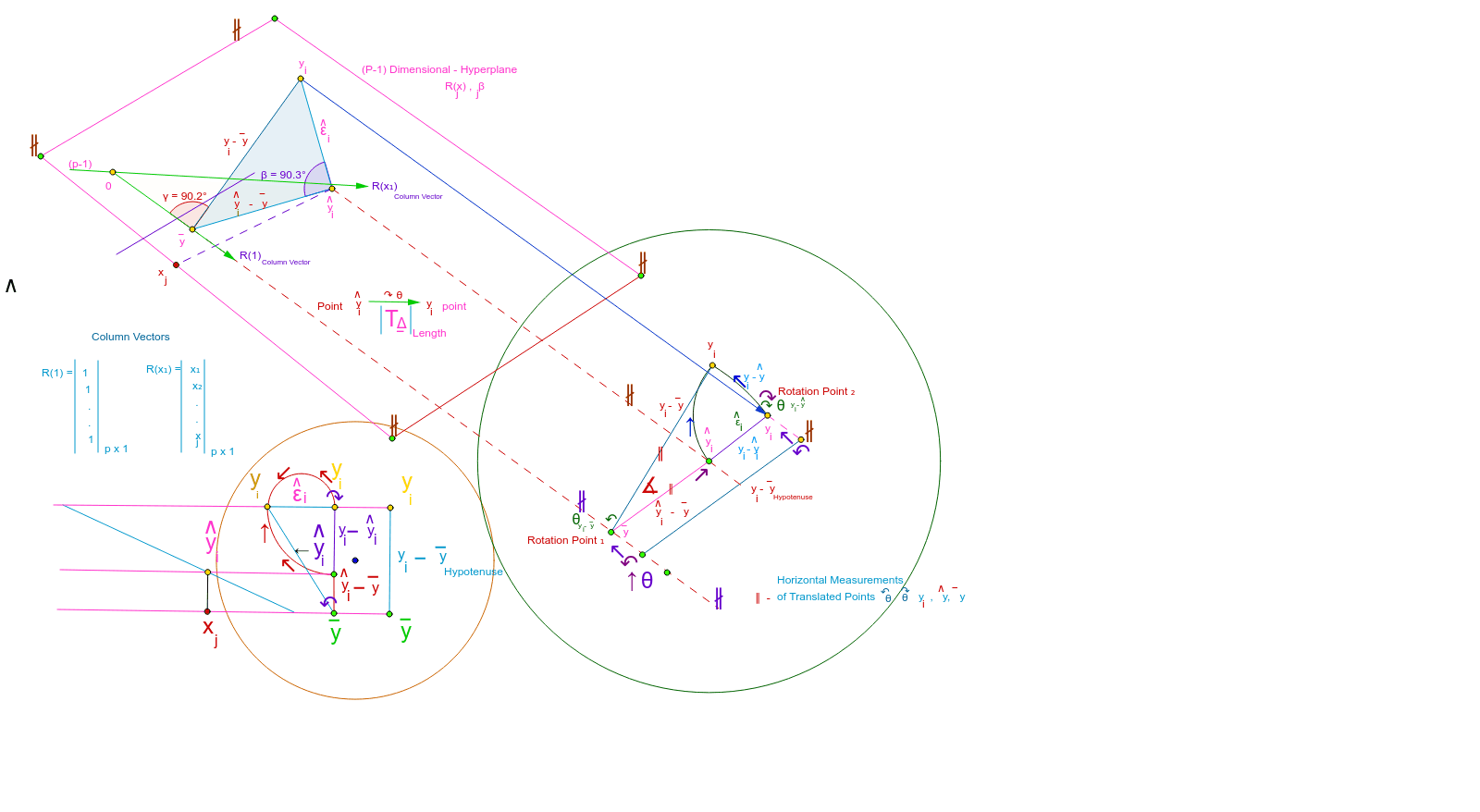
This example demonstrates the geographic relationship of the Regression Analysis Equation Y=XB+e. It involves core math concepts like linear regression, data fitting, and error analysis. Construction highlights include using GeoGebra commands such as Polygon, Mirror, Angle, Point, Segment, Line, OrthogonalLine, Vector, Translate, Intersect, Rotate, CircleArc, and Circle. Suitable for high school students and beginners in data analysis.
GeoGebra Commands & Parameters
Polygon(A, B, Y, D) → poly1, a, b, c, dPolygon(D, B, A) → poly2, a_1, d_1, b_1Mirror(D, a) → D'Mirror(B, a) → B'Mirror(A, a) → A'Polygon(D', B', A') → poly2', a', d', b'Polygon(A, B, Y) → poly3, c_1, a_2, b_2Angle(b', d) → αAngle(Y, B, A) → βPoint(a) → ESegment(Y, E) → eAngle(Y, A, D) → γAngle(e, a) → δPolygon(C, F, G) → poly4, g, c_2, fLine(H, b_1) → hLine(I, a_1) → iPoint(h) → JPoint(h) → KSegment(J, K) → jPoint(i) → LPoint(i) → MSegment(L, M) → kSegment(N, O) → lSegment(P, Q) → mOrthogonalLine(R, xAxis) → nMirror(P, n) → P'Mirror(Q, n) → Q'Segment(P', Q') → m'Mirror(N, n) → N'Mirror(O, n) → O'Segment(N', O') → l'Vector(T, U) → uTranslate(A, u) → A'_1Translate(B, u) → B'_1Translate(Y, u) → Y'Polygon(A'_1, B'_1, Y') → poly3', y', a'_1, b'_1Vector(V, W) → vTranslate(F, v) → F'Translate(G, v) → G'Segment(F', G') → pSegment(G', G) → qVector(Z, A_1) → wTranslate(L, w) → L'Translate(M, w) → M'Segment(L', M') → k'Vector(B_1, C_1) → sTranslate(J, s) → J'Translate(K, s) → K'Segment(J', K') → j'Vector(D_1, E_1) → tTranslate(B, t) → B'_2Translate(A, t) → A'_2Segment(B'_2, A'_2) → e_1Intersect(g, f) → F_1Segment(A, E) → f_1Intersect(y', b'_1) → G_1Segment(Y, G_1) → g_1Line(H_1, f) → h_1Line(I_1, f) → i_1Line(J_1, f) → j_1Point(h_1) → K_1Segment(K_1, H_1) → k_1Point(i_1) → L_1Point(j_1) → M_1Segment(L_1, M_1) → l_1Point(i_1) → N_1Point(k_1) → O_1Segment(N_1, O_1) → m_1Point(j_1) → P_1Segment(O_1, P_1) → n_1Rotate(O_1, 90*°, O_1) → Q_1Rotate(P_1, -90*°, P_1) → S_1Segment(N_1, P_1) → q_1Rotate(N_1, 22*°, N_1) → T_1Rotate(P_1, 22*°, N_1) → U_1Segment(T_1, U_1) → r_1Rotate(P_1, -88*°, P_1) → V_1Rotate(O_1, -85*°, P_1) → W_1Rotate(P_1, -85*°, P_1) → Z_1Segment(Z_1, U_1) → p_1Segment(E, Q_1) → s_1Intersect(y', a'_1) → R_1Intersect(a'_1, b'_1) → A_2Segment(Y, B_2) → t_1Segment(Q_1, C_2) → d_2Point(i_1) → D_2Point(d_2) → F_2Segment(A, G_2) → g_2Vector(H_2, Z_1) → u_1Vector(I_2, Q_1) → v_1Vector(J_2, T_1) → w_1Vector(K_2, L_2) → u_2Vector(M_2, N_2) → v_2Intersect(j, k) → O_2Intersect(k', j') → P_2Point(g_2) → Q_2Vector(O_2, Q_2) → w_2Point(k) → R_2Point(k) → S_2Vector(R_2, S_2) → h_2Segment(G', F_1) → i_2Segment(F', T_2) → rSegment(F_1, T_2) → j_2Point(i_2) → x_jSegment(E, x_j) → k_2Segment(U_2, V_2) → l_2Segment(W_2, Z_2) → m_2Segment(A_3, B_3) → n_2Segment(C_3, D_3) → p_2Segment(W_2, E_3) → q_2Intersect(m_2, n_2) → F_3Point(p_2) → G_3Segment(F_3, G_3) → r_2CircleArc(Z_1, U_1, Q_1) → s_2Vector(H_3, I_3) → u_3CircleArc(T_1, Z_1, U_1) → t_2Segment(Z_1, M_1) → e_2Point(p) → E_2Segment(K_3, L_3) → f_2Line(M_3, f_2) → a_3Mirror(K_3, a_3) → N_3Mirror(L_3, a_3) → O_3Segment(N_3, O_3) → b_3Vector(Y, Z_1) → v_3Segment(D_3, E_3) → c_3Point(q_2) → P_3Segment(B_3, P_3) → d_3Point(p_2) → Q_3Segment(B_3, Q_3) → e_3Point(q_2) → R_3CircleArc(P_3, R_3, B_3) → g_3Point(q_2) → S_3CircleArc(S_3, P_3, R_3) → f_3Segment(P_3, R_3) → h_3Segment(R_3, Q_3) → i_3Segment(R_3, T_3) → j_3Segment(P_3, E_3) → k_3Circle(V_3, W_3) → p_3Circle(Q_1, Z_3) → q_3
AI Drawing Prompt Reference
Draw a geometric representation of the regression analysis equation Y=XB+e, involving multiple polygons and geometric relationships to illustrate data fitting and error analysis. Start by creating two symmetric polygons, then use mirroring and rotation to generate new shapes. Add error lines and parallel lines based on angles and vectors, and finally demonstrate the transformation of the equation through translation, showcasing the geographic relationship of linear regression.
The prompt above was compiled from the original drawing commands and is for reference only.