
Descriptive Geometry
Loading the math board and drawing, please wait…
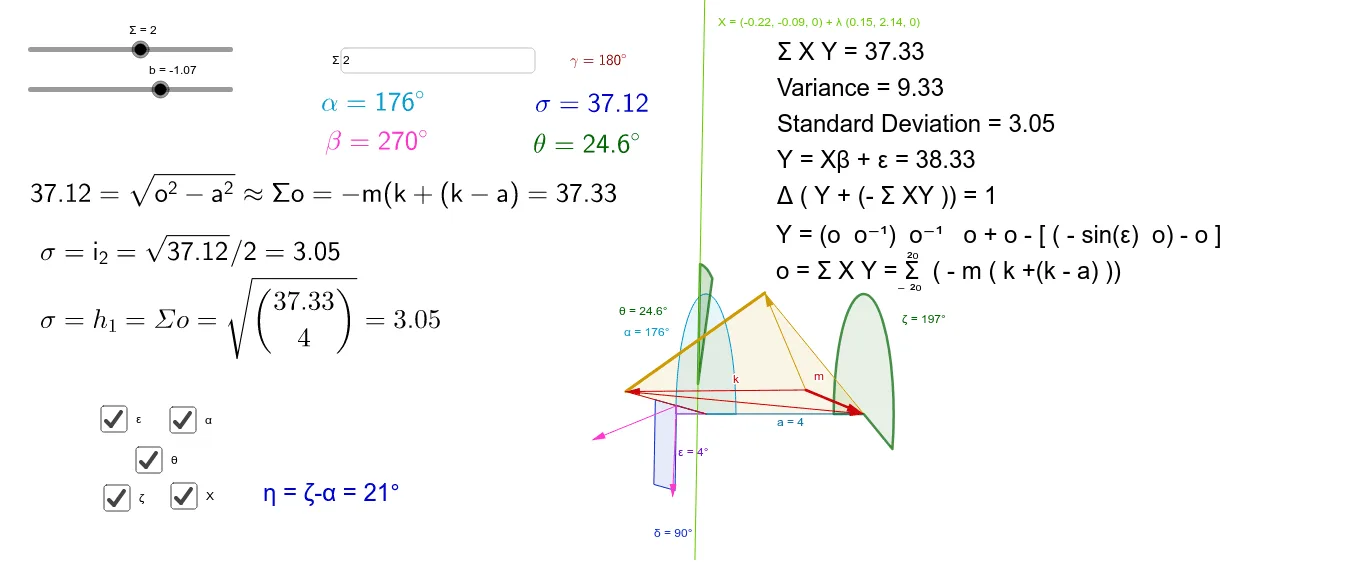
This example demonstrates basic geometric construction methods in descriptive geometry. The core math concepts involved include vectors, points, segments, angles, orthogonal lines, translation, polygons, reflection, dilation, rotation, etc. Construction highlights involve using commands and objects like Vector, Point, Segment, Angle, OrthogonalLine, Translate, Polygon, Mirror, Dilate, Rotate, Line, Textfield in GeoGebra. Suitable for high school and above students to learn geometric construction techniques.
GeoGebra Commands & Parameters
Vector((5.17, 0), (7, 3)) → qVector((1, 0), (1, 1)) → wPoint(v) → APoint(u) → B_2Segment(A, B_2) → cPoint(xAxis) → CSegment(A, C) → dAngle(C, A, B_2) → αOrthogonalLine(D, u, xOyPlane) → eAngle(c, e, xOyPlane) → βPoint(c) → EPoint(c) → FPoint(d) → GVector(H, I) → gPoint(d) → A'Translate(B_2, g) → B'Segment(A', B') → c'Polygon(E, F, B', A') → poly1, e_1, f_1, b', aVector(B', E) → hVector(J, K) → iTranslate(B_2, i) → BVector(C, B) → jVector(B, B_2) → kVector(B, B') → lMirror(A, c) → A'_1Dilate(j, 2, L) → j'Rotate(j', (-(90°)), B) → j''Dilate(j'', 0.25, L) → j'''Point(j''') → NPoint(j') → MVector(O, P) → pTranslate(F, p) → F'Vector(Q, R) → rTranslate(B, r) → SVector(T, U) → sTranslate(A, s) → A'_2Vector(V, W) → u_1Translate(S, u_1) → S'Vector(B, A') → mVector(B_2, A') → nPoint(c) → ZOrthogonalLine(Z, u) → tLine(Z, u) → a_1Rotate(a_1, 15°, Z) → b_1Angle(c, t) → δVector(A_1, B_1) → v_1Translate(Z, v_1) → Z'Vector(Z, Z') → w_1Vector(C_1, D_1) → c_1Translate(Z, c_1) → Z'_1Vector(Z, Z'_1) → d_1Angle(c, a) → εTextfield(Σ) → InputBox1Point(b') → G_1Line(G_1, b') → f_2Angle(f_2, a) → ζPoint(e) → H_1Point(s_1) → I_1Segment(H_1, I_1) → g_2Angle(g_2, e, xOyPlane) → θ
AI Drawing Prompt Reference
Draw a geometric figure that includes vectors and points, demonstrating basic construction methods. Start by creating two vectors, then form points based on the first vector and connect them to create a line segment. Next, use points on the coordinate axes and vectors to perform transformations like translation, rotation, reflection, and dilation, creating multiple polygons and geometric objects. Finally, complete the construction using angles and orthogonal lines, showcasing fundamental geometric concepts such as vectors, points, line segments, and polygons.
The prompt above was compiled from the original drawing commands and is for reference only.