
Orbit around the Planets 2a: Multi-body Motion and Geometric Construction
Loading the math board and drawing, please wait…
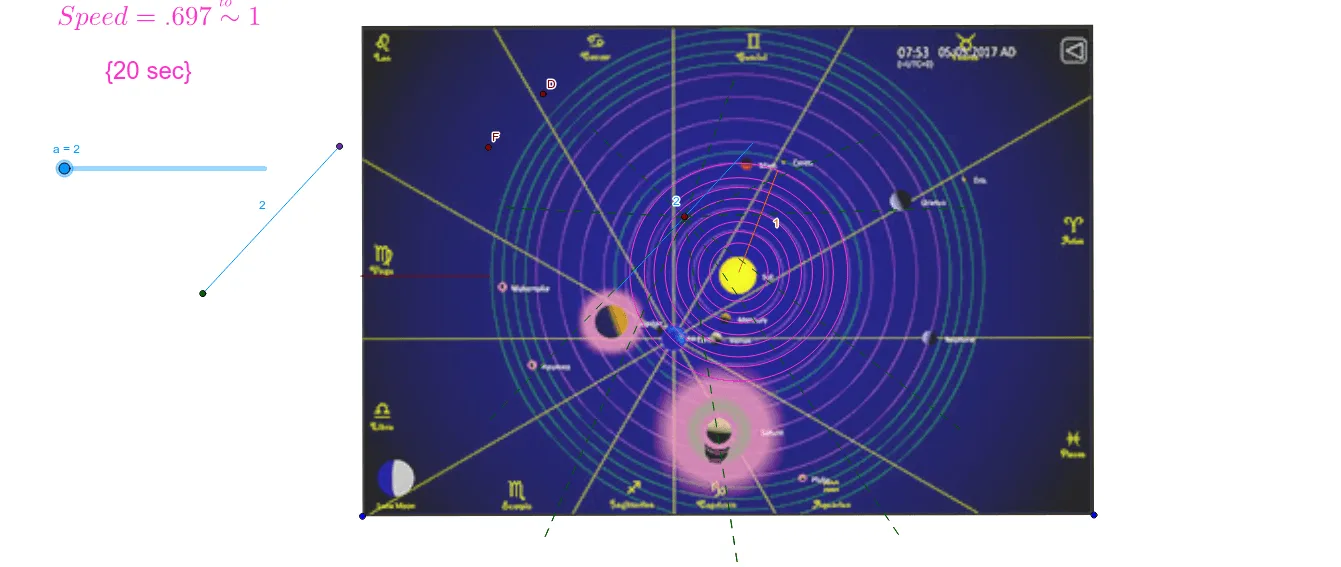
This example demonstrates orbital motion around multiple planets, using dynamic geometry to visualize celestial trajectories and related geometric relationships. Core mathematical concepts include circles, conic sections, coordinate geometry, vector translation, and subtraction, while also incorporating statistical elements such as distributions and binomial distribution, though the primary focus remains geometric construction and motion simulation. Construction highlights: GeoGebra commands such as Point, Segment, Polygon, Slope, Circle, Area, PointIn, Line, Intersect, Name, Midpoint, Vector, and Translate are used to build multiple points, segments, polygons, circles, and vector objects, with sliders or parameters controlling orbital changes. Suitable for middle or high school mathematics or physics classes to demonstrate planetary motion, geometric transformations, and coordinate relationships, as well as to explore intersections between conic sections and statistical distributions.
GeoGebra Commands & Parameters
Point(b) → APoint(c) → BSegment(C, A) → dSegment(C, B) → fPoint(c) → DSegment(B, D) → iPoint(Circle[A, 1.4142135623730951]) → FSegment(A, F) → gSegment(A, F) → hPolygon(B, C, D) → poly1, d_1, b_1, c_1Segment(C, D) → d_hPoint(c) → EPoint(c) → GSegment(B, G) → τSegment(F, G) → nSlope(n) → mSlope(d_h) → m_1Circle(C, A) → kArea(k) → ePointIn(k) → PointkLine(H, f) → jIntersect(k, j, 2) → ISegment(C, I) → lLine(I, b) → pIntersect(p, d) → JSegment(C, J) → qSegment(J, I) → sPoint(s) → KSegment(C, K) → tSegment(I, F) → a_1Segment(J, A) → e_1Polygon(C, I, F, G, B) → poly2, c_2, i_1, f_1, g_1, b_2Name(o) → A1Name(u) → B1Name(a) → C1Point(k) → LCircle(M, N) → h_1Point(h_1) → OPoint(h_1) → PMidpoint(O, P) → QSegment(M, O) → j_1Segment(z_1, z_2) → k_1Vector(T, U) → vTranslate(z_1, v) → z_3Translate(z_2, v) → z_4Segment(z_3, z_4) → l_1Point(l_1) → VSegment(V, W) → n_1Segment(V, Z) → p_1Segment(V, A_1) → q_1Segment(V, B_1) → r_1Segment(V, C_1) → s_1Segment(V, D_1) → t_1Segment(V, E_1) → a_2Segment(V, F_1) → d_2Segment(V, G_1) → e_2Point(j_1) → H_1Circle(H_1, I_1) → f_2Circle(H_1, J_1) → g_2Circle(H_1, K_1) → h_2Circle(H_1, L_1) → k_2Circle(H_1, M_1) → p_2Circle(H_1, N_1) → q_2Circle(H_1, O_1) → r_2Point(h_1) → P_1Circle(H_1, P_1) → s_2Segment(V, Q_1) → i_2