
Refraction of Light at a Dielectric Surface
Loading the math board and drawing, please wait…
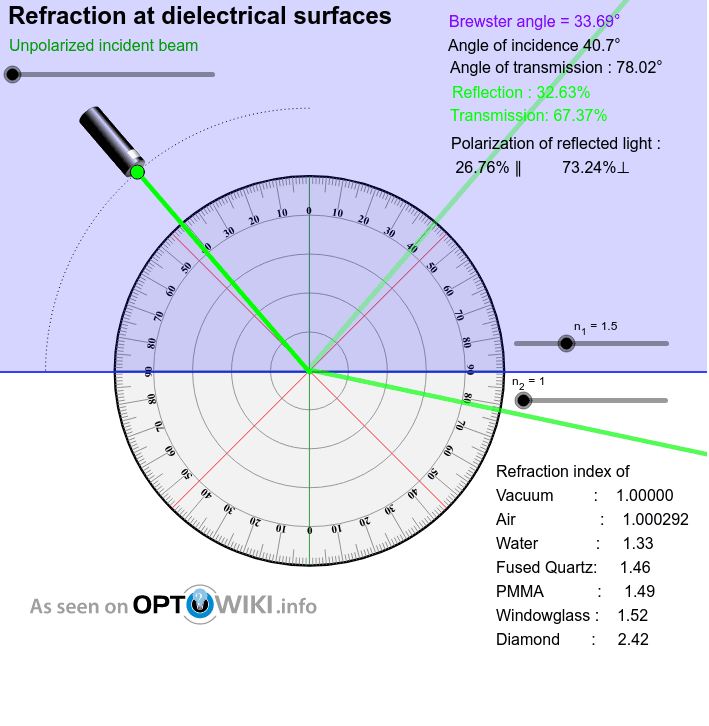
This example demonstrates the refraction of light at a dielectric surface. Key mathematical concepts include Snell's Law and trigonometric functions. Using GeoGebra commands such as Point, Circle, Intersect, etc., the path of light in different media can be constructed. Suitable for high school physics and mathematics education, aiding students in understanding the principles of light refraction.
GeoGebra Commands & Parameters
Point(yAxis) → DCircle(C, D) → cIntersect(c, xAxis, 1) → ECircleArc(C, D, NonZeroE) → CircularArcForLaserPoint(CircularArcForLaser) → FRay(C, H) → TransmittedRayPoint(TransmittedRay) → PSegment(F, C) → IncidentRayRay(C, F) → fPoint(f) → IPoint(f) → JCircle(I, J) → gOrthogonalLine(I, f) → hIntersect(g, h, 2) → KLine(K, f) → iOrthogonalLine(F, f) → jIntersect(i, j) → LRay(C, F') → ReflectedRayAngle(atan(n_2 / n_1)) → Θ_BPoint(ReflectedRay) → GPolygon(C, G, M, N) → poly1, c_1, g_1, m, nPolygon(C, C1, C2, C3) → poly2, c_2, c1, c2, c3If(Θ_t ≟ NaN, 100, If[Polarized ≟ 0, MeanPercentReflected, If[Polarized ≟ 1, ReflectedPercentParallel, ReflectedPercentPerpendicular]]) → PercentReflectedIf(Polarized ≟ 0, MeanPercentTransmitted, If[Polarized ≟ 1, TransmittedPercentParallel, TransmittedPercentPerpendicular]) → PercentTransmittedIf(Θ_t ≠ NaN, 0, 1) → TotalReflection