
Newton's Rings Between Spheres
Loading the math board and drawing, please wait…
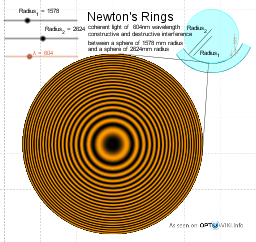
This example demonstrates the phenomenon of Newton's rings between spherical surfaces, dynamically showing the formation of interference fringes. Core mathematical concepts include spherical geometry, quadratic functions, sine functions, and conditional probability. Construction highlights involve GeoGebra commands and objects like Circle, If, Point, Segment, CircumcircleArc, Polygon, and Intersect, as detailed in the construction summary. Suitable for high school students and math enthusiasts studying wave optics and geometric modeling.
GeoGebra Commands & Parameters
Circle(A, UpdateRadius) → UpdateCircleIf((390 ≤ λ) ∧ (λ ≤ 440), (440 - λ) / 50, If[(440 < λ) ∧ (λ ≤ 510), 0, If[(510 < λ) ∧ (λ ≤ 570), (λ - 510) / 60, If[680 < λ, λ / 1000, 1]]]) → RIf((390 ≤ λ) ∧ (λ ≤ 440), 0, If[(440 < λ) ∧ (λ ≤ 480), (λ - 440) / 40, If[(480 < λ) ∧ (λ ≤ 580), 1, If[(580 < λ) ∧ (λ ≤ 640), (640 - λ) / 60, If[680 < λ, λ / 1000, 0]]]]) → GIf((390 ≤ λ) ∧ (λ ≤ 490), 1, If[(490 < λ) ∧ (λ ≤ 510), (510 - λ) / 20, If[680 < λ, λ / 1000, 0]]) → BCircle(C, 1.5) → cPoint(c) → DSegment(D, C) → bPoint(c) → ESegment(H, I) → fSegment(H_1, I_1) → u_1Segment(N, O) → gSegment(N, P) → iCircle(Q, S) → kCircle(Q, T) → pPoint(k) → UPoint(p) → VPoint(k) → WPoint(p) → ZCircumcircleArc(U, S, W) → rCircumcircleArc(V, T, Z) → tPoint(r) → A_1Point(r) → B_1Point(r) → C_1Point(r) → D_1Point(r) → E_1Point(t) → F_1Point(t) → G_1Point(t) → J_1Point(t) → K_1Point(t) → L_1Point(t) → M_1Point(t) → N_1Polygon(V, U, N_1, M_1, L_1, K_1, T, J_1, G_1, F_1, A_1, B_1, S, C_1, D_1, E_1, W, Z) → poly2, v, z_1, n_1, m_1, l_1, k_1, t_1, j_1, g_1, f_1, u, a_1, b_1, s_1, c_1, d_1, e_1, wIntersect(r, u, 2) → FSegment(Q, F) → dSegment(H_2, I_2) → f_2