
Reflections of the Orthocenter in Cevian Lines and a Three-Circle Concurrency
Loading the math board and drawing, please wait…
In collections
A Tour of Triangle Geometry
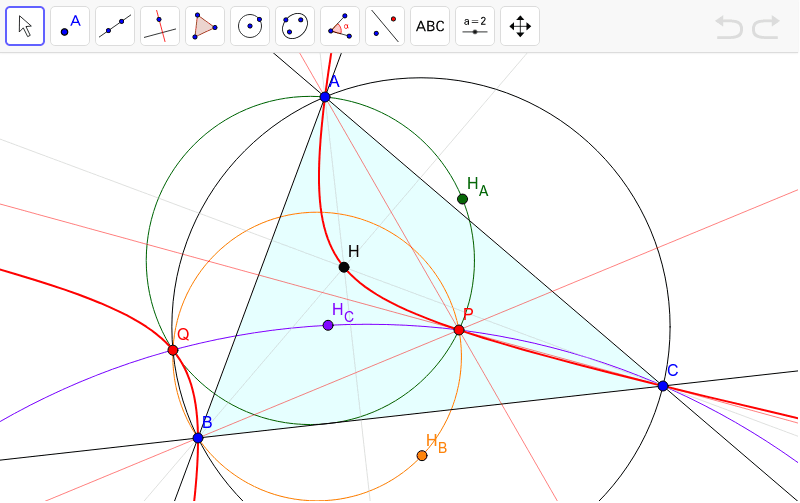
①This example demonstrates a striking geometric phenomenon: for any point P, reflect the orthocenter H of a triangle across the three cevian lines AP, BP, and CP to obtain points Ha, Hb, Hc, then construct circles APHa, BPHb, and CPHc—these three circles always meet at a common point Q.②The core mathematical concepts involve the orthocenter of a triangle, cevian lines (lines from a vertex to the opposite side or its extension), reflection transformations, and the concurrency of three circles, showcasing the elegant interplay of symmetry and concurrence in classical Euclidean geometry.③Construction highlights: according to the construction summary, GeoGebra commands such as Line, OrthogonalLine, Intersect, Mirror, Circle, Conic, and Polygon are used to create vertices A, B, C, an arbitrary point P, the orthocenter H, reflected points H_A, H_C, H_B, circles k, p, q, and the intersection point Q.④This is suitable for high school and above students or geometry enthusiasts, ideal for exploring reflection properties of the orthocenter, three-circle concurrency theorems, and dynamic geometry experiments—dragging point P reveals the locus of Q.
GeoGebra Commands & Parameters
Line(A, B) → aLine(B, C) → bLine(C, A) → cOrthogonalLine(A, b) → dOrthogonalLine(B, c) → eOrthogonalLine(C, a) → fIntersect(d, e) → HLine(A, P) → gLine(B, P) → hLine(C, P) → iMirror(H, g) → H_AMirror(H, i) → H_CMirror(H, h) → H_BCircle(A, H_A, P) → kCircle(C, P, H_C) → pCircle(B, H_B, P) → qIntersect(k, p, 2) → QConic(A, H, B, P, C) → rPolygon(A, B, C) → poly1, c_1, a_1, b_1Circle(A, B, C) → s
AI Drawing Prompt Reference
Draw a triangle ABC and its orthocenter H. Choose an arbitrary point P and draw lines AP, BP, CP from the vertices to P. Reflect the orthocenter H across these lines to get points H_A, H_B, H_C. Then draw three circles: APH_A, BPH_B, and CPH_C. These circles intersect at a common point Q. Moving point P reveals the locus of Q.
The prompt above was compiled from the original drawing commands and is for reference only.