
RED Circle Game: Dynamic Geometry and Probability Exploration
Loading the math board and drawing, please wait…
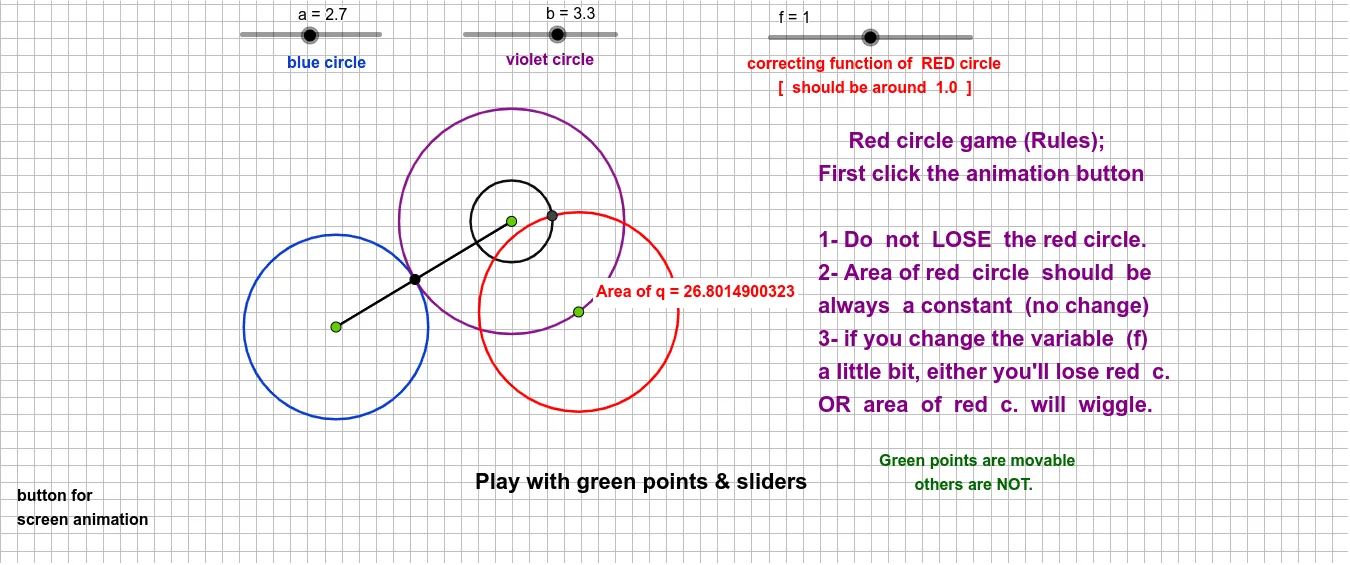
① This example demonstrates an interactive geometric construction called the 'RED Circle Game', where users click or move points to observe dynamic changes of a red circle, involving area, intersections, and symmetry. ② Core mathematical concepts include relationships between circles and triangles (circumcircle, centroid), geometric transformations (symmetry, translation), area calculation, and the probabilistic idea of geometric distribution, with implicit counting via natural numbers and arithmetic. ③ Construction highlights: from the summary, GeoGebra commands such as Point, Circle, Area, Segment, Intersect, and PointIn are used, creating multiple points (A, D, E, F, B), circles (a, c, d), segments (l, g, h), and text objects (text1 to text7), with interactive point (Pointq) and text (Textq) for game feedback. ④ Suitable for middle school geometry teaching or math game design, useful for understanding circle properties, centroid concepts, area comparison, and probability simulation, as well as a fun case for dynamic geometry exploration.
GeoGebra Commands & Parameters
Point(Circle[A, a + b]) → DCircle(D, a - 1.5) → kArea(k) → lSegment(A, D) → gCircle(A, a) → cArea(c) → hIntersect(c, g, 1) → ECircle(D, E) → dArea(d) → iPoint(d) → FCircle(A, F) → eIntersect(e, k, 2) → BCircle(F, B) → pCircle(F, B) → qArea(q) → jPointIn(q) → Pointq
AI Drawing Prompt Reference
On the same plane, construct several related circles and displayed area regions to form a dynamic “circle game”. First define a movable point D based on the given circle parameters, then draw a circle k centered at D and indicate the area of that circle. Draw a segment g joining the original reference point A to D. Next draw a circle c centered at A, find its intersection with segment g at E, and draw another circle d centered at D passing through E; show the area for circle d. Choose a point F on circle d, then draw a circle e centered at A through F. Compute intersections of circles e and k to obtain B, and draw two circles p and q centered at F passing through B. Indicate the area of circle q, and include a feedback point representing whether a point lies inside q.
The prompt above was compiled from the original drawing commands and is for reference only.