
Rectangular Prism - Surface Area and Volume
Loading the math board and drawing, please wait…
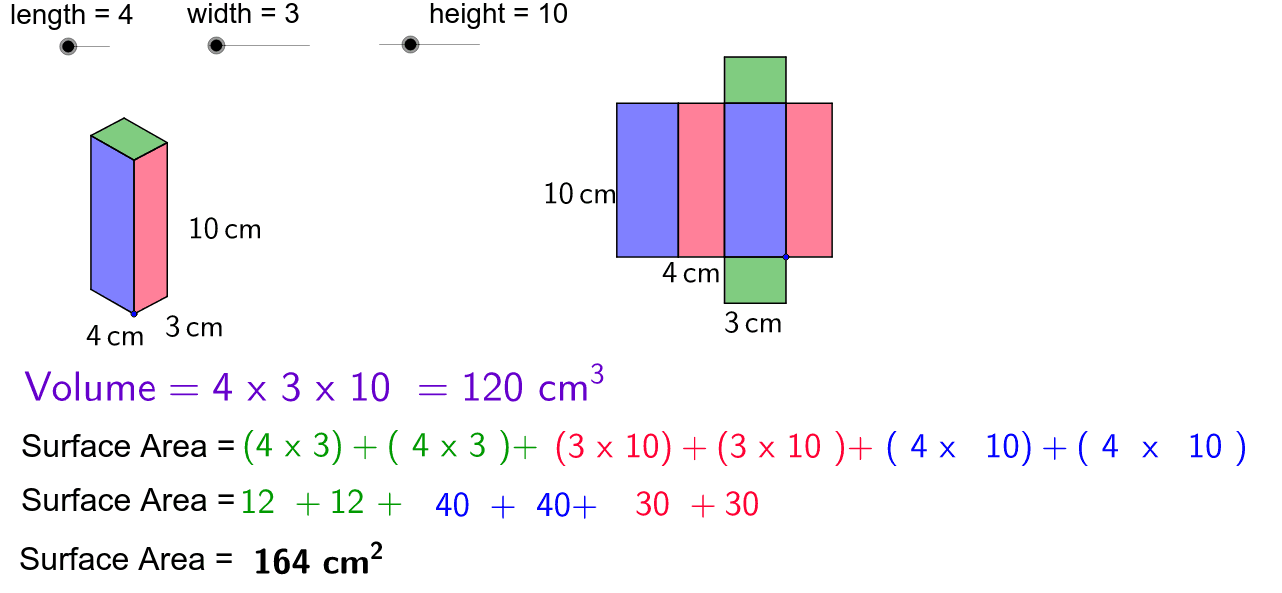
This GeoGebra example demonstrates the construction of a rectangular prism (also known as a cuboid) and visualizes its surface area and volume. It covers core concepts in solid geometry: prisms, surface area, volume, and the use of vectors and translations to build 3D shapes. The construction uses commands such as Vector, Translate, Polygon, Line, Intersect, and Midpoint, with parameters for length, width, and height. Vertices A, B, C, D and vectors u, v, w are defined, then translated to form the prism's faces (poly1, poly2, poly3), with auxiliary lines and midpoints for clarity. This resource is suitable for middle and high school students learning about 3D geometry, surface area and volume formulas, and for teachers to illustrate dynamic parameter changes. It also serves as a hands-on exploration tool for understanding how dimensions affect a prism's measurements.
GeoGebra Commands & Parameters
Vector(A, B) → uVector(A, C) → vVector(A, D) → wTranslate(E, Vector[(height * u)]) → E'Vector(E, E') → zTranslate(E, Vector[(width * w)]) → E'_1Translate(E, Vector[(length * v)]) → E'_2Translate(E'_2, Vector[(height * u)]) → FTranslate(E'_1, Vector[(height * u)]) → GPolygon(F, E'_2, E, E') → poly1, f, e'_2, e, e'Polygon(E, E'_1, G, E') → poly2, e_1, e'_1, g, e'_3Line(F, g) → dLine(G, e') → hIntersect(d, h) → HPolygon(F, E', G, H) → poly3, f_1, e'_4, g_1, h_1Polygon(J, I, K, L) → poly4, j, i, k, lPolygon(N, J, I, M) → poly5, n, j_1, i_1, mPolygon(N, P, O, M) → poly6, n_1, p, o, m_1Polygon(Q, R, N, J) → poly7, q, r, n_2, j_2Polygon(T, S, I, M) → poly8, t, s, i_2, m_2Polygon(V, U, O, P) → poly9, v_1, u_1, o_1, p_1Midpoint(e'_2) → WMidpoint(e_1) → ZMidpoint(e'_1) → A_1Midpoint(v_1) → B_1Midpoint(u_1) → C_1Midpoint(o) → D_1Midpoint(m_2) → E_1Midpoint(t) → F_1
AI Drawing Prompt Reference
Draw a rectangular prism by defining four vertices A, B, C, and D, and three vectors u, v, and w. Use vector and translation commands to construct the six faces of the prism, including poly1, poly2, poly3, poly4, poly5, poly6, poly7, poly8, and poly9. Add auxiliary lines d and h, and their intersection point H to form poly3. Mark the midpoints of each face, such as W, Z, A_1, etc., for better observation.
The prompt above was compiled from the original drawing commands and is for reference only.