
Triangular Prism - Surface Area and Volume
Loading the math board and drawing, please wait…
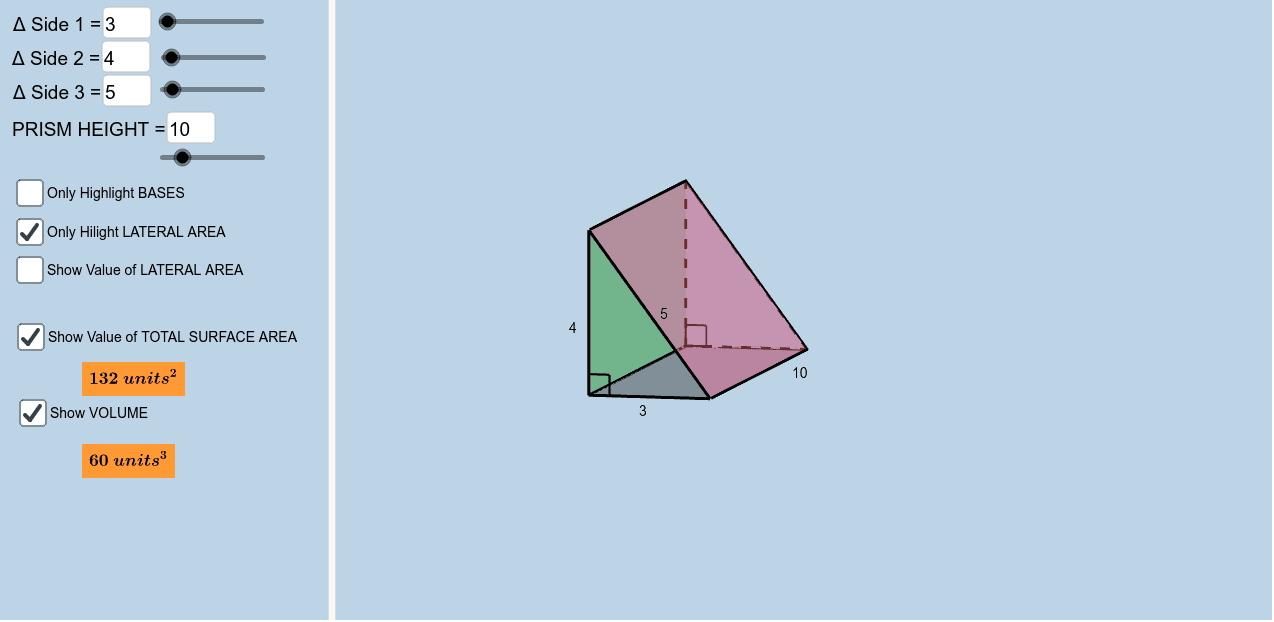
This example demonstrates how to calculate the surface area and volume of a triangular prism. The core mathematical concepts involved include area, prism, surface area, volume, real numbers, tangent line, and power functions. The construction utilizes GeoGebra commands such as Circle, Point, Ray, Intersect, Segment, OrthogonalLine, Polygon, Vector, Translate, Angle, and Textfield, along with objects like A, a, b, c, h, d, e, B, f, C, D, E, F, g, k, p, G, H, i, I, j, l, m, poly1, e_1, a_1, g_1, u, poly1', G', E', l', A, G_1, j, A_1, E_1, g, G_2, I. It is suitable for middle school students and above to learn and understand solid geometry.
GeoGebra Commands & Parameters
Circle(A, a, xOyPlane) → dPoint(e) → BRay(A, B) → fIntersect(e, f) → CIntersect(e, f) → DIntersect(f, d) → E, FSegment(A, E) → gCircle(A, b, xOyPlane) → kCircle(E, c, xOyPlane) → pIntersect(k, p) → G, H, ,OrthogonalLine(G, g, xOyPlane) → iIntersect(i, g) → ISegment(A, G) → jSegment(G, E) → lSegment(G, I) → mPolygon(A, G, E) → poly1, e_1, a_1, g_1Vector(A, (0, 0, (-h))) → uTranslate(poly1, u) → poly1'Translate(G, u) → G'Translate(E, u) → E'Segment(G', E') → l'Translate(A, u) → A'Translate(G, u) → G'_1Segment(A', G'_1) → j'Translate(A, u) → A'_1Translate(E, u) → E'_1Segment(A'_1, E'_1) → g'Translate(G, u) → G'_2Translate(I, u) → I'Segment(G'_2, I') → m'Angle(E, I, G, xOyPlane) → αPolygon(E, E', G', G) → poly2, e_2, e', g'_1, g_2Polygon(A, A', G', G) → poly3, a_2, a', g'_2, g_3Polygon(A, A', E', E) → poly4, a_3, a'_1, e'_1, e_3Segment(G, G') → nSegment(E, E') → qSegment(A', A) → rAngle(E', I', G'_1) → βTextfield(a) → InputBox1Textfield(b) → InputBox2Textfield(c) → InputBox3Textfield(h) → InputBox4
AI Drawing Prompt Reference
Draw a triangular prism with base triangle AEG and side triangle AEG'. First, draw the base triangle AEG. Then, draw a circle k and a circle p through point E, and their intersection points are G and H. Next, draw the side triangle AEG' by drawing a line segment AG through point A and E. Finally, translate points A, G, and E down by h units to get A', G', and E', and connect A'G' and E'G'.
The prompt above was compiled from the original drawing commands and is for reference only.