
Rectangle Maker by Melanie Palma
Loading the math board and drawing, please wait…
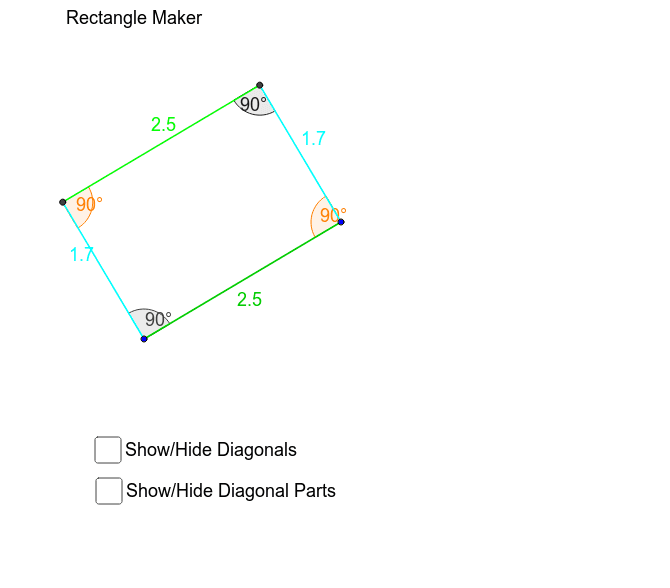
This example demonstrates the dynamic construction of a rectangle and its related geometric elements. It involves core math concepts like line segments, angles, orthogonal lines, circles, intersections, and similarity transformations. The construction utilizes GeoGebra commands such as Line, Segment, Circle, OrthogonalLine, Intersect, Angle, and Point. Suitable for high school mathematics teaching, explaining geometric constructions, transformations, and the application of related concepts.
GeoGebra Commands & Parameters
Line(P, A) → aLine(E, a) → bSegment(A, P) → gLine(L, O) → iCircle(L, O) → kOrthogonalLine(P, a) → cIntersect(b, c) → COrthogonalLine(A, g) → dIntersect(b, d) → DSegment(C, D) → eSegment(A, D) → fSegment(P, C) → hAngle(A, P, C) → αAngle(P, A, D) → βAngle(A, D, C) → γAngle(D, C, P) → δCircle(O, L) → pPoint(p) → BLine(B, i) → jLine(O, B) → lLine(L, l) → mIntersect(j, m) → FSegment(O, B) → nSegment(L, F) → rSegment(B, F) → sSegment(O, L) → qAngle(O, B, F) → εAngle(F, L, O) → ζAngle(B, F, L) → ηAngle(B, O, L) → θSegment(B, L) → diag_1Segment(F, O) → diag_2Intersect(diag_1, diag_2) → GSegment(F, G) → diag_2aSegment(G, O) → diag_2bSegment(B, G) → diag_1aSegment(L, G) → diag_1bAngle(F, G, L) → diag_angleSegment(C, A) → diagr_1Segment(D, P) → diagr_2Intersect(diagr_1, diagr_2) → HSegment(D, H) → diagr_1aSegment(P, H) → diagr_1bSegment(C, H) → diagr_2aSegment(A, H) → diagr_2b
AI Drawing Prompt Reference
Draw a dynamic rectangle including its sides, diagonals, circumcircle, and incircle. Start by drawing one side of the rectangle and a perpendicular line, then use the intersection points of the perpendicular line and a circle to determine the other two vertices of the rectangle. Next, draw the diagonals and find their intersection point. Finally, add angle markings and auxiliary lines to illustrate the geometric properties and similarity transformations related to the rectangle.
The prompt above was compiled from the original drawing commands and is for reference only.